Let us know how we can help
Sales & Pricing
Speak to a rep about your business needs

Help & Support
See our product support options
General inquiries and locations
Contact us


 Control-M + Azure Functions
Your Azure Functions workflow starts before an HTTP-triggered function ever executes — and it can fail when something upstream breaks. An Azure Blob Storage upload never arrives from Azure Data Factory. An Azure Databricks job overruns its processing window before publishing its output. Control-M orchestrates the full chain: Azure Blob Storage arrival, Azure Databricks transformation, Azure Functions execution, and downstream delivery.
common workflow issues
Does this sound like your week?
These aren’t edge cases. They’re the normal operating conditions for teams running Azure Functions across multiple tools. Here’s how Control-M handles each one.
UPSTREAM DELAY
The blob arrived at 2:17 AM. Your function was already expected.
Control-M coordinates the upstream transfer and Azure Functions execution as dependencies in one workflow, starting the function only when its prerequisite completes successfully and preventing downstream work from advancing against missing or late data.
FUNCTION FAILURE
The function failed. Three downstream jobs are still waiting.
Control-M monitors Azure Functions status, results, and output, applies workflow-level failure handling, and keeps dependent jobs from advancing after an unsuccessful execution — containing the failure instead of letting it cascade across the production workflow.
DURABLE EXECUTION
Your orchestrator is still running. The delivery window is closing.
Control-M executes and monitors Orchestrator functions alongside surrounding jobs, with configurable status polling and failure tolerance. SLA management adds deadline awareness across the complete workflow, helping operations identify risk before a long-running execution delays delivery.
AUTHENTICATION
The function is healthy. The calling identity no longer authenticates.
Control-M centralizes Azure Functions credentials in a secure connection profile, with supported identity options including Service Principal, Managed Identity, and Workload Identity. External-vault support helps keep secrets out of individual job definitions and scripts.
SLA RISK
It’s 5:45 AM. The function succeeded, but processing is late.
A successful function invocation does not guarantee the business workflow is on time. Control-M attaches SLA management to Azure Functions jobs and tracks surrounding dependencies, exposing schedule risk across the end-to-end service rather than one serverless execution.
Control‑M + Azure Functions
Control‑M + Azure Functions
|
API and automation capabilities |
Control-M Automation API · REST API · JSON job definitions · Job:Azure:Functions · Activity functions · HTTP functions · Orchestrator functions · configurable input parameters |
|
Deployment models & infrastructure flexibility |
Control-M SaaS · self-hosted Control-M · hybrid environments · Control-M Web · Automation API · Windows Agent · Linux Agent · any Azure Functions endpoint |
|
Security posture |
centralized connection profiles · Service Principal · Managed Identity · Workload Identity · Function App ID · external vault integration · Azure resource scope · centralized credential management |
|
Incident response & MTTR enablement |
status and output monitoring · configurable status polling · failure tolerance · dependency-based containment · SLA monitoring · advanced scheduling · resource controls · Durable Function termination |
end-to-end orchestration
One production workflow. Every tool in the stack.
Control-M orchestrates workflows across Azure Functions, Azure Data Factory, Azure Databricks, Azure Blob Storage, file transfers, and cloud services in a single job flow — with dependency tracking, SLA visibility, and automated recovery across all of them.
- Cross-tool dependency: Azure Blob Storage → Azure Databricks → Azure Functions → downstream delivery
- Data-aware triggers: file arrival, API event, upstream job completion, function result
|
Azure Functions |
Activity execution · HTTP execution · Orchestrator execution · status monitoring · output retrieval |
|
Azure Data Factory |
pipeline orchestration · execution dependencies · status tracking · downstream handoff |
|
Azure Databricks |
job execution · notebook workflows · status monitoring · dependency coordination |
|
Azure Blob Storage |
file arrival dependency · data handoff · downstream processing trigger · delivery coordination |
|
Managed File Transfer |
secure transfer · file arrival detection · delivery confirmation · exception handling |
|
REST APIs |
service invocation · response handling · status validation · cross-application dependencies |
|
Microsoft Azure services |
cloud workload coordination · dependency management · scheduling · SLA tracking |
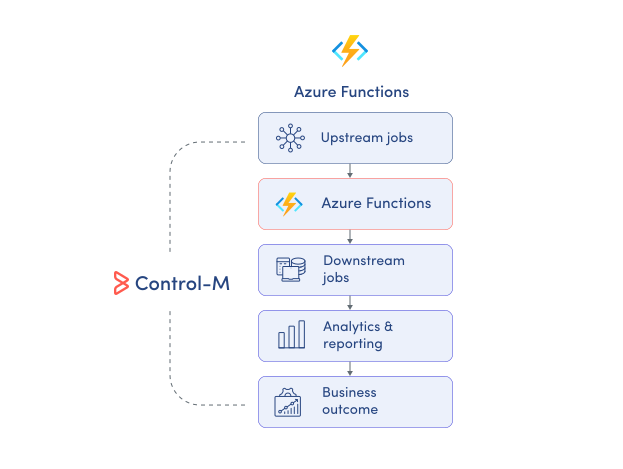
MONITOR FUNCTIONS
Azure Functions across the complete production workflow.
Azure Application Insights provides deep telemetry for individual function apps, but production services frequently span systems outside that telemetry boundary. Control-M adds a centralized workflow view of Azure Functions execution and the upstream and downstream jobs surrounding it:
-
Function execution status
-
Results and output visibility
-
Cross-platform workflow dependencies
-
End-to-end runtime history
-
SLA risk indicators
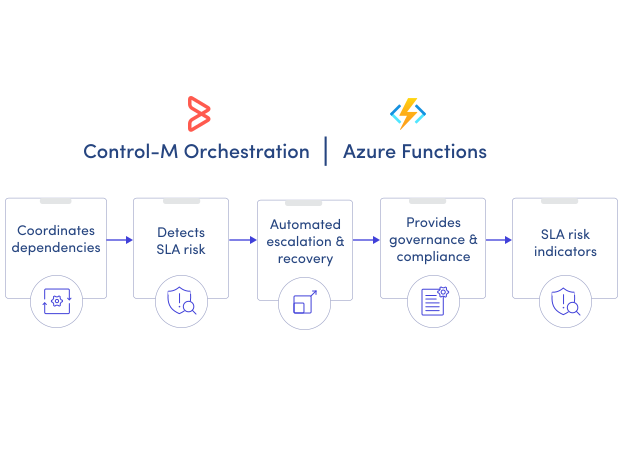
SLA ASSURANCE
Keep serverless workflows aligned to business deadlines.
Azure Functions monitoring tells teams how function executions behave, but a healthy invocation can still belong to a late business service. Control-M adds SLA management and dependency-aware orchestration across the complete workflow so teams can manage delivery risk:
-
End-to-end SLA tracking
-
Dependency-aware scheduling
-
Workflow deadline visibility
-
Failure cascade prevention
-
Proactive operational intervention
Documentation
Bring order to complex workflows
Learn how Control-M helps teams orchestrate complex processes with greater visibility, coordination, and control.
