Let us know how we can help
Sales & Pricing
Speak to a rep about your business needs

Help & Support
See our product support options
General inquiries and locations
Contact us


 Control-M + AWS CloudFormation
Your AWS CloudFormation workflow starts before a stack deployment ever provisions a single resource — and it can fail when something upstream breaks. An AWS CodeBuild build artifact never uploads to the Amazon S3 deployment bucket. An AWS CodePipeline approval action expires before the template clears its review stage. Control-M orchestrates the full chain: Amazon S3 template staging, AWS CodeBuild packaging, AWS CloudFormation execution, and AWS CodeDeploy delivery.
common workflow issues
Does this sound like your week?
These aren’t edge cases. They’re the normal operating conditions for teams running AWS CloudFormation deployments across multiple tools. Here’s how Control‑M handles each one.
DEPLOYMENT GATING
Your pipeline finished. CloudFormation is still waiting on a manual approval.
CI completes successfully, but production deployment pauses until someone manually approves or triggers the stack update. Control-M orchestrates approval gates, evaluates deployment conditions, launches the CloudFormation stack automatically, and records every step for a consistent, auditable release process.
STACK FAILURE
Stack rollback completed. Downstream jobs already started.
A CloudFormation rollback occurs after a failed resource deployment, but dependent workflows continue executing. Control-M detects stack completion status, prevents downstream execution after failed or rolled-back stacks, triggers configurable recovery actions, and protects the rest of the delivery pipeline.
CROSS-ACCOUNT
Infrastructure deployed in one AWS account. The next environment never starts.
Multi-account deployments often depend on successful completion in development, staging, or shared services accounts. Control-M coordinates cross-account CloudFormation deployments, validates completion states, manages dependencies, and automatically advances the workflow only when prerequisite environments succeed.
CHANGE SETS
Change Set approved. Nobody executed the deployment.
CloudFormation Change Sets help reduce deployment risk, but execution frequently depends on manual intervention. Control-M automates Change Set creation, approval workflows, execution, and downstream validation, eliminating unnecessary delays while maintaining governance and operational control.
DRIFT DETECTION
Production drift was detected after deployment. Nobody caught it.
Infrastructure changes outside CloudFormation can introduce configuration drift that impacts future deployments. Control-M orchestrates drift detection, validation workflows, notification processes, and remediation tasks so infrastructure issues are identified before they become production outages.
INTEGRATION FACTS
Control‑M + AWS CloudFormation
|
API and automation capabilities |
AWS CloudFormation API · AWS CLI · Change Sets · StackSets · Control-M Automation API · REST API |
|
Deployment models & infrastructure flexibility |
AWS public cloud · multi-account deployments · multi-region deployments · hybrid workflow orchestration · Control-M SaaS · Control-M on-premises · Infrastructure as Code (IaC) pipelines |
|
Security posture |
AWS IAM roles · AWS Assume IAM Role cross-account authentication · least-privilege access · encrypted in transit · audit logging · role-based access control (RBAC) · SAML/SSO |
|
Incident response & MTTR enablement |
automated retry with configurable policies · stack status monitoring · rollback detection · downstream dependency protection · SLA breach alerting · notification workflows · automated recovery orchestration |
end-to-end orchestration
One production workflow. Every tool in the stack.
Control-M orchestrates workflows across AWS CloudFormation, GitHub Actions, Jenkins, Terraform, Amazon ECS, AWS services, and ITSM platforms in a single job flow—with dependency tracking, SLA visibility, and automated recovery across all of them.
- Cross-tool dependency: Git commit → Jenkins build → CloudFormation stack deployment → Amazon ECS workload → Atlassian Jira change closure
- Data-aware triggers: Git push, Change Set approval, API event, stack completion
|
AWS CloudFormation |
Stack creation · stack updates · Change Set execution · StackSets orchestration · stack status monitoring · rollback detection |
|
GitHub Actions |
Workflow trigger · pipeline orchestration · release coordination · deployment automation |
|
Jenkins |
Build completion trigger · pipeline orchestration · artifact dependency management · status tracking |
|
Terraform |
Infrastructure workflow coordination · dependency sequencing · coexistence with CloudFormation · deployment governance |
|
Amazon ECS |
Post-provisioning container deployment · workload orchestration · health validation · application rollout sequencing |
|
Atlassian Jira |
Change approval integration · deployment governance · incident creation · automated ticket updates |
airflow coexistance
Control‑M doesn’t replace your Airflow DAGs. It runs the layer above them.
The objection is common: “we’re already on Airflow.” The issue isn’t what Airflow does – it’s what happens before and after Airflow runs. That’s where pipelines actually fail.
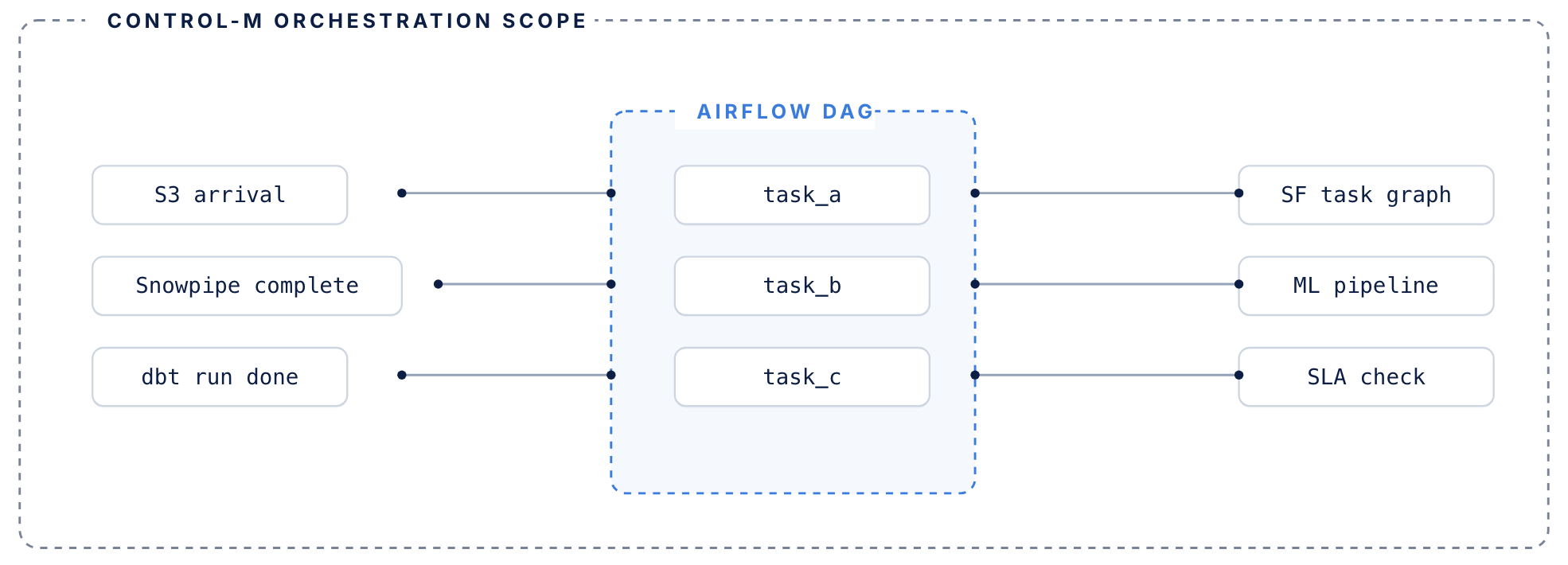
Airflow manages its DAG. Control-M manages everything surrounding it.
AIRFLOW HANDLES
DAG-level orchestration inside the data pipeline
- DAG-level task orchestration within a data pipeline
- Python operators, sensors, and task dependencies
- Execution graphic for jobs that run inside your pipeline
- Manages retries within a single DAG context
CONTROL-M ADDS
The coordination layer around your DAGs
- Coordination layer around DAGs — triggers Airflow based on upstream conditions: file arrivals, API events, other tool completions
- Tracks each DAG’s SLA contribution across the full end-to-end workflow, not just its own routine
- Manages failure recovery when upstream dependencies fail before Airflow even starts
- Existing DAGs don’t need to be rewritten or migrated
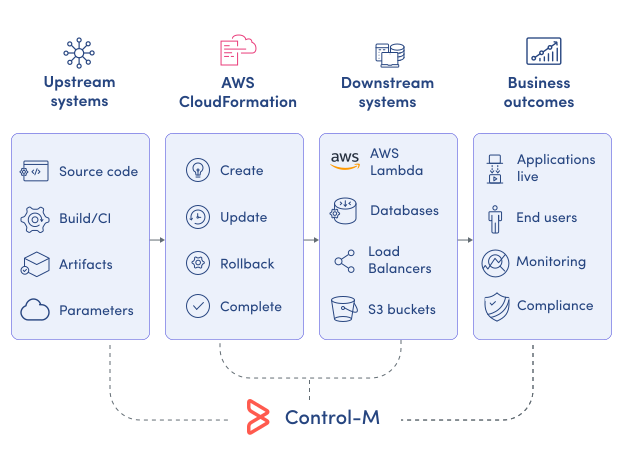
MONITOR DEPLOYMENTS
Monitor AWS CloudFormation deployments from a single operational view.
AWS CloudFormation provides stack-level visibility, but it doesn't show how infrastructure provisioning affects the broader delivery workflow. Control-M delivers centralized monitoring across your deployment pipeline, giving operations teams complete execution context, dependency visibility, and proactive operational insight:
-
Stack execution status
-
Deployment timeline history
-
Cross-workflow dependencies
-
SLA risk monitoring
-
Centralized operational dashboard
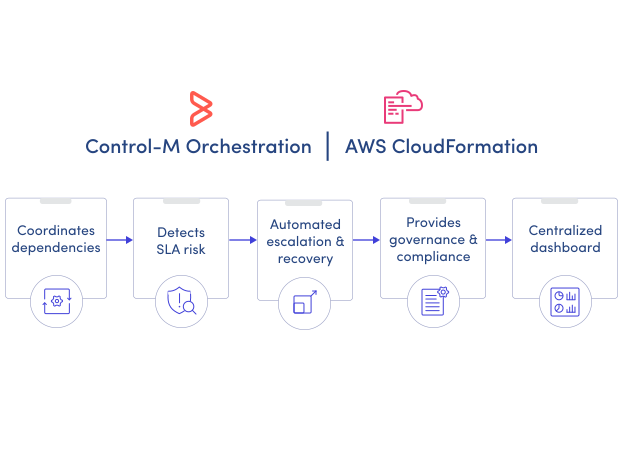
AUTOMATED RECOVERY
Recover from CloudFormation failures before they impact production.
CloudFormation reports deployment failures and rollbacks, but recovery across connected platforms often remains manual. Control-M detects failed stack states, prevents downstream execution, automates recovery workflows, and coordinates notifications so issues are resolved faster with less operational effort:
-
Rollback detection
-
Automated retry policies
-
Dependency-aware recovery
-
Intelligent alerting
-
Controlled downstream execution
Documentation
Bring order to complex workflows
Learn how Control-M helps teams orchestrate complex processes with greater visibility, coordination, and control.
