Let us know how we can help
Sales & Pricing
Speak to a rep about your business needs

Help & Support
See our product support options
General inquiries and locations
Contact us


Mainframe DevOps applies version control, automated build and test, and governed deployment to COBOL, PL/I, JCL, and Assembler applications on z/OS. Source can live in Enterprise Git, in BMC AMI DevX Code Pipeline, or in both. Build, promotion, deployment, and audit run on z/OS through Code Pipeline either way, and your existing orchestrators and compliance controls stay in place.
Two paths to the same pipeline
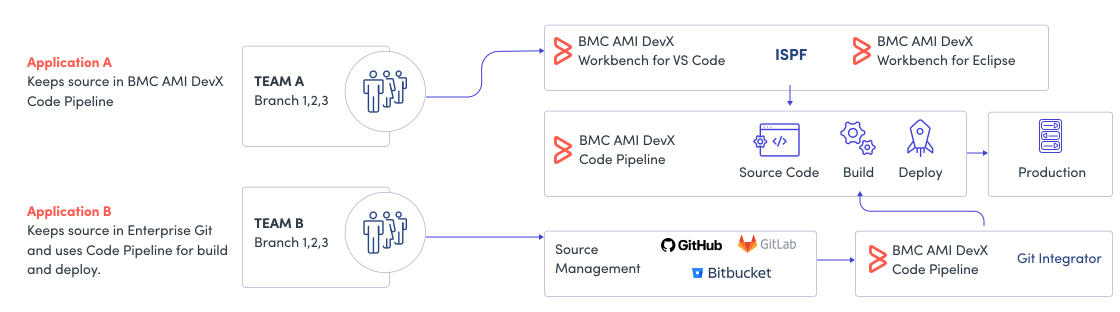
Teams reach mainframe CI/CD from two directions. BMC AMI DevX Code Pipeline supports both, and the mainframe behaves the same way on either path.
Code Pipeline holds the source
Code Pipeline operates as the source code manager with feature branching, and interoperates with Git workflows where the rest of the organization works. Teams moving off Endevor or ChangeMan start here.
Enterprise Git holds the source
GitHub, GitLab, Bitbucket, or Azure Repos stays the system of record. Code Pipeline runs build, promotion, deployment, and audit on z/OS. Your orchestrator triggers it through webhooks, REST, or the command line.
Code Pipeline takes an open-borders approach. Source lives where your teams work, and build, deploy, and audit run on z/OS through one set of governed pipelines. Teams change paths without rebuilding the pipeline.
How one pipeline runs from commit to production on z/OS
Walk a single change from commit to production through BMC AMI DevX Code Pipeline.
1. A change enters the pipeline
Source lands in Enterprise Git under pull request rules, or in Code Pipeline under an assignment. Either way, a webhook fires your orchestrator.
2. Your orchestrator calls Code Pipeline
Jenkins, GitHub Actions, Azure DevOps, or GitLab CI/CD invokes BMC AMI DevX Code Pipeline through REST, the command line, or a DevOps Extension. No custom bridging code.
3. Code Pipeline builds on z/OS
Modular compile skeletons compile COBOL, PL/I, JCL, and Assembler and resolve copybooks, running natively on z/OS.
4. Code Pipeline tracks component dependencies
Programs, copybooks, and called programs move through the lifecycle with their relationships intact. Impact Analysis surfaces the downstream components a change affects, and every action writes to the audit trail.
5. Code Pipeline promotes approved changes
Promotion moves approved changes through lifecycle stages, applying environment configuration and enforcing approvals at each gate.
6. Code Pipeline deploys and keeps a fallback path
Real-time status across target environments, approvals issued from web or mobile, and partial or full fallback to a valid previous version when a deploy goes wrong.
What z/OS adds to your pipeline, and what closes it
These differences determine whether your pipeline remains the control point or becomes a coordinator passing instructions to systems it does not govern.
| Dimension | Your distributed pipeline | What z/OS adds | What BMC AMI DevX Code Pipeline provides |
|---|---|---|---|
| Source of truth | Git repository | Source may live in Git, in a mainframe SCM, or in both | Operates as the source code manager with feature branching, or as the build and deploy layer under Enterprise Git |
| Build | Compile and package portable artifacts | Compile, link-edit, and resolve copybooks against the target system | Modular compile skeletons covering COBOL, PL/I, JCL, and Assembler |
| Governance | Policy-driven, often external to the pipeline | Approvals audited per change | Approvals at each promotion gate from web or mobile, with a full audit trail |
| Recovery | Redeploy the previous artifact | Fallback restores the running program in place | Partial or full fallback to a valid previous version on demand |
Where BMC AMI DevX Code Pipeline operates in the CI/CD architecture
Code Pipeline runs the mainframe side of the lifecycle. It manages source, or it takes source from Enterprise Git. It builds, promotes, deploys, and records every action on z/OS. Distributed orchestrators drive it through webhooks, REST, or the command line, and results return to the pipeline that called it.
Code Pipeline is the CI/CD layer of BMC AMI DevX, BMC's mainframe developer productivity platform.
Mainframe DevOps results with Code Pipeline
15x
more code changes per year
50%
reduction in toolchain administration costs
6x
faster deployment frequency (Fortune 100 financial services customer)
$7.1M
three-year present value from increased release frequency
How mainframe DevOps keeps one governed record
Everything is recorded as it happens. One execution path captures build, promotion, approval, and deployment as they happen. BMC AMI DevX Code Pipeline supports fallback to valid previous versions with lifecycle visibility and audit controls.
Concurrency works without collisions
Developers work on interdependent components at the same time. Code Pipeline tracks lifecycle state for every component and every version, so parallel work stays visible and Impact Analysis surfaces conflicts before they reach production.
One execution path across the platform boundary
The same execution path governs distributed and z/OS changes.
Intent and execution stay connected
Intent is recorded where your teams work, in a pull request or in a Code Pipeline assignment. Execution is governed in the pipeline. The record of what shipped, when, and who approved it lives in one place.
Governance stays inside the pipeline
Approvals and promotion controls are enforced within the pipeline execution flow, and every action writes to the audit trail.
SBOM generation for z/OS applications
The pipeline already holds the record. Every promotion, approval, and deployment writes to it, along with the components each change touched. Producing a component inventory from that record becomes a job you schedule rather than a project you staff.
Distributed CI/CD platforms generate SBOMs for containers and packaged artifacts. They do not cover the COBOL, PL/I, JCL, and Assembler applications running on z/OS.
The EU Cyber Resilience Act mandates SBOMs for market access. Article 8 of the EU Digital Operational Resilience Act requires financial entities to identify and document their ICT assets and keep those inventories current.
BMC AMI DevX Code Pipeline generates the SBOM through a batch job teams schedule inside the pipeline they already run. The output is CycloneDX JSON covering program names and versions, copybooks, and called programs for the components Code Pipeline manages. The inventory refreshes as often as the job runs.
- Compliance evidence on demand: provenance and supply chain transparency for the components Code Pipeline manages.
- Faster vulnerability response: component inventory exists before an event.
- Evidence that stays current: the inventory refreshes as often as the job runs.
Read the Datasheet
Mainframe DevOps FAQs
What is mainframe DevOps and how does it integrate with enterprise CI/CD pipelines?

Which mainframe DevOps platforms support Jenkins, GitLab CI, GitHub Actions, and Azure DevOps integration?
How do enterprises manage mainframe software deployments with fallback and promotion workflows?
How can enterprises extend Agile and DevOps practices to mainframe development teams?
What does migration look like from Endevor, ChangeMan, or similar SCMs?
Can I run mainframe CI/CD without moving source to Git?
How do I generate a software bill of materials for COBOL applications on z/OS?
Mainframe DevOps FAQs
What is mainframe DevOps and how does it integrate with enterprise CI/CD pipelines?
Which mainframe DevOps platforms support Jenkins, GitLab CI, GitHub Actions, and Azure DevOps integration?
How do enterprises manage mainframe software deployments with fallback and promotion workflows?
How can enterprises extend Agile and DevOps practices to mainframe development teams?
What does migration look like from Endevor, ChangeMan, or similar SCMs?
Can I run mainframe CI/CD without moving source to Git?
How do I generate a software bill of materials for COBOL applications on z/OS?

TrustRadius awards for BMC AMI DevX
BMC AMI DevX has earned consecutive Top Rated awards and a Buyer's Choice award from TrustRadius, reflecting sustained customer satisfaction. Users recognized the solution for modernizing mainframe development, improving code quality, and enabling faster, more secure delivery across enterprise environments.