Let us know how we can help
Sales & Pricing
Speak to a rep about your business needs

Help & Support
See our product support options
General inquiries and locations
Contact us


Get More from Your SAP Optimization
Why modern business services now depend on orchestration beyond the ERP core
The connected enterprise
Orchestrating SAP and non-SAP workflows for a more connected enterprise
Organizations are investing in SAP S/4HANA to modernize business processes and prepare for broader AI adoption. But completing an S/4HANA migration does not guarantee success. The real challenge is ensuring the investment delivers your desired business outcomes.
Success depends on the workflows, data feeds, batch jobs, and process dependencies around SAP operating as expected. This execution layer is where you can encounter the most migration risks.
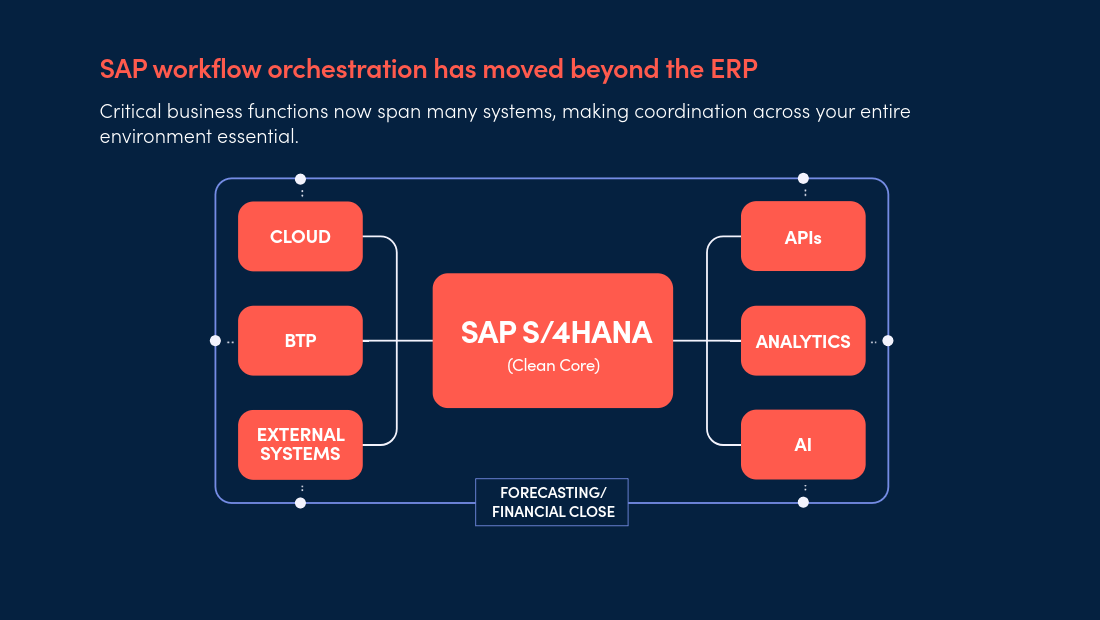
For years, SAP environments were relatively centralized, with workflows and business processes contained within the enterprise resource planning (ERP). Today, business execution depends on cloud services, external applications, data platforms, and AI workflows operating beyond the ERP core.
Clean core strategies accelerate this shift by moving more execution responsibility outside SAP. When those systems and dependencies lack governance, you can face risks such as delayed revenue recognition and disrupted supply chains.
Whether you're planning your SAP optimization, mid-migration, or already live on S/4HANA, you need to ask: Is everything around our ERP governed well enough to protect what we've built?
Answering "yes" to that question means you have a significant opportunity. In today's data-rich and AI-driven environments, SAP workflow orchestration is critical. Connecting and coordinating business workflows across systems, data, and infrastructure can give you a clearer view of how work moves through your organization. That visibility can help you improve decision-making and accelerate business outcomes.
Read on to learn why the organizations getting the most return from their SAP investments are the ones governing everything around the ERP, not just inside it.
Key takeaway:
Migrating to SAP S/4HANA is only part of the journey. Real business value depends on governing the workflows, data, and systems that operate beyond the ERP.
ISG research finds nearly 60% of SAP migrations run over budget and behind schedule1. Protecting what you've already built starts with what happens around the migration, not just inside it.
The challenge
The clean core orchestration challenge
If you’re pursuing a clean core strategy, you want to reduce customizations inside SAP S/4HANA and standardize your ERP as much as possible. The benefits are simpler upgrades and faster technology adoption, as you don’t need to create custom code.
But there’s a trade-off. Critical business functions such as order-to-cash, forecasting, and supply chain coordination often depend on both SAP and non-SAP systems working together. As clean core strategies reduce customization inside SAP, more process coordination has to happen across the connected systems around it. These systems may include data platforms such as SAP Business Data Cloud, Snowflake, and Databricks, along with cloud services and AI-powered applications. Clean core orchestration becomes increasingly important for maintaining visibility and control across those dependencies.
Without orchestration, the processes your business depends on can become fragmented. For example, if an overnight SAP batch job that exports inventory or order data finishes late, a downstream forecasting system may use incomplete inputs. This can cause planning teams to work from outdated demand signals, even though SAP itself is operating normally. Effective SAP and non-SAP orchestration helps ensure those dependencies continue to operate as expected.
Key takeaway:
A clean core simplifies SAP but increases orchestration complexity outside the ERP. Effective SAP workflow orchestration depends on connected systems operating together.
CASE STUDY

REWE digital: Maintaining business continuity during SAP optimization
REWE digital provides IT systems for one of Europe's largest retail and tourism companies. To support SAP optimization efforts, the company migrated SAP applications off the mainframe and adopted a hybrid environment. Control-M orchestrated workflows across multiple technologies while helping REWE digital maintain reliable operations across 7,500+ stores and 250 distribution centers during the transition.
Impact:
- 100% uptime in production3
- Reliable product delivery to 7,500+ stores3
- End-to-end visibility across supply chain workflows

“After a flawless migration to Control-M, we are moving into the future, integrating new technologies into a rock-solid application and data workflow orchestration environment.”
Frank Rothmann | Senior Product Owner, REWE digital
Why AI Raises the Stakes
Why AI increases the need for SAP workflow orchestration
Organizations are rapidly adding AI assistants, agents, and autonomous workflows to their SAP environments. Solutions such as SAP Joule and AI agents in SAP Business Technology Platform (BTP) can automate tasks and accelerate business processes. But as these technologies become embedded in more workflows, they also become harder to govern.
The issue becomes even more complex in clean core environments. As functionality moves beyond the ERP, AI agents can trigger actions across systems that SAP doesn’t govern. Without orchestration, failures can go unnoticed until they impact business-critical processes.
Maintaining oversight requires orchestration across AI agents, data, and business processes. This helps AI deliver business value, rather than adding complexity as adoption grows.
As you move toward becoming an Autonomous Enterprise4, where people set direction and governed AI executes at every step5, agentic orchestration becomes critical. Effective SAP and non-SAP orchestration helps agents operate in a trusted way, with SLA enforcement, audit trails, and recovery built in.
Key takeaway:
AI can accelerate execution, but only when the agents, data, and workflows behind it work together.
"Across every industry, AI is accelerating, and workflows are becoming more dynamic than ever. The enterprises that lead will be the ones that build a trusted orchestration foundation now."
Abhijit Kakhandiki | SVP & GM, Digital Business Automation, BMC Software
Understanding the impact of hidden dependencies
Universal orchestration gives you a complete view of your dependencies so you can see how changes in one area might affect another. Simulated test runs and continuous monitoring help you predict and confirm outcomes before you go live.
Without universal orchestration
Unknown impacts
With universal orchestration
Visible dependencies and Predicted outcomes
Building a foundation for the Autonomous Enterprise
Visibility
A complete view of connected workflows, dependencies, and business services.
Governance
End-to-end oversight across SAP and non-SAP environments.
Trust
Embedded resilience and control to automate with confidence.
Key takeaway:
Organizations that get the most value from SAP optimization focus on execution from the start, instead of treating it like an afterthought.
CASE STUDY

Supporting reliable retail operations at scale
With more than 1,400 outlets and 48,000 employees, Coop is Switzerland's largest retail and wholesale company. Control-M helps the retailer run approximately 140,000 SAP jobs each day, providing a single point of control for the workloads that keep stores operating and pricing accurate. The platform also helps Coop improve visibility and identify potential issues before they affect the business.
Business outcomes:
- Increased staff productivity
- Potential issues identified before they disrupt operations
- Scalability to support rapid growth
“We have job flows that start a batch process in one SAP system, transfer the data to another for processing, and then return the processed data back to the first system. We just couldn’t handle this workload complexity and volume without the automation provided by Control-M.”
Stephan Conrad, ICT System Specialist | Coop
Why Control-M
Why Control-M for SAP and non-SAP orchestration?
As your SAP environment becomes more distributed, orchestration is increasingly important to maintain visibility and minimize risk. That's where Control-M can help.
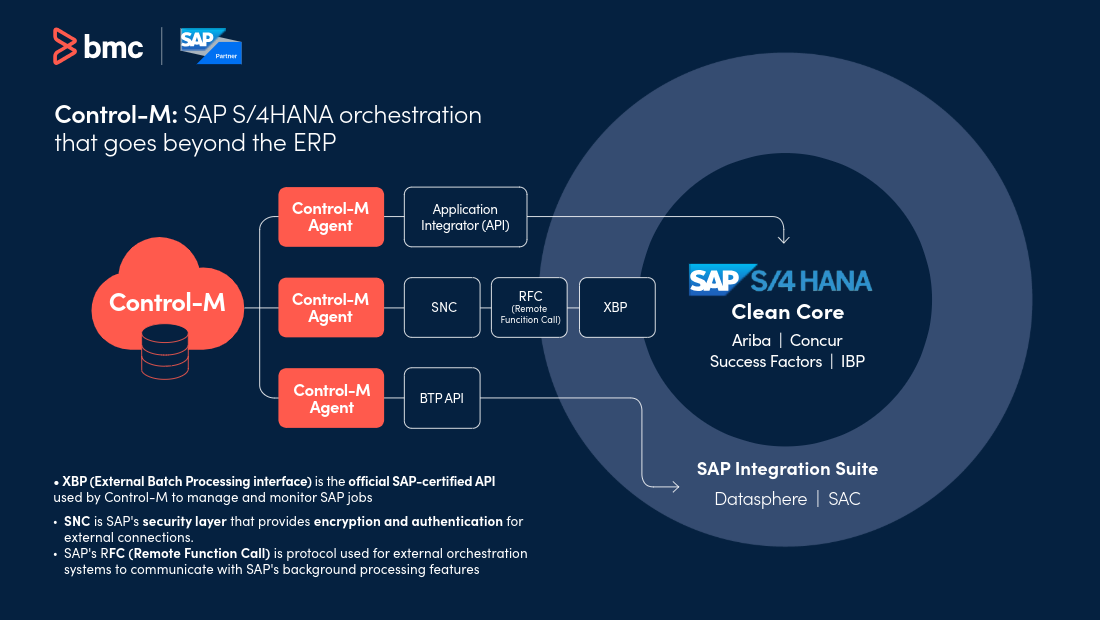
Control-M is a universal orchestration platform that automates workloads across SAP and non-SAP systems. It supports SAP S/4HANA migrations and RISE with SAP by orchestrating the workflows that extend beyond your ERP. The result is reduced SAP migration execution risk, stronger governance, and deeper visibility into critical business processes. Gartner names BMC (Control-M) a Leader in the August 2026 Gartner® Magic Quadrant™ for Service Orchestration and Automation Platforms3, recognizing the same orchestration capabilities that reduce SAP migration risk and strengthen governance across connected systems.
Universal orchestration
Orchestrate workflows across SAP, cloud, data, and AI environments from a single control layer for end-to-end SAP workload automation.
Migration Confidence
Simulate ECC and S/4HANA workloads side by side to validate outcomes before cutover and reduce migration risk.
Governed AI and Agentic Workflows
Enable AI orchestration and agentic AI orchestration across SAP and non-SAP environments with built-in governance.
The SAP workflow orchestration readiness checklist
- S/4HANA or RISE with SAP migration initiatives are underway.
- AI agents or AI-driven workflows are being introduced into business processes.
- Critical business services depend on both SAP and non-SAP systems.
- Business processes extend beyond SAP into cloud, data, or AI platforms.
- Teams use multiple tools to monitor and manage workflows.
- Visibility into cross-system dependencies is limited.
- SLA tracking and governance are managed across multiple tools.
- Teams spend significant time troubleshooting workflow failures across SAP, data, and cloud environments
If you checked four or more boxes, it may be time to evaluate a more unified approach to SAP workflow orchestration.
See exactly where your migration is exposed. Take the SAP Migration Readiness Assessment for a personalized risk summary you can act on.
SAP workflow orchestration: FAQs
How does Control-M support SAP S/4HANA orchestration?

What do I need to govern with RISE with SAP orchestration?
What gaps are in SAP clean core orchestration?
What should organizations consider when choosing an SAP BPA replacement?
How does SAP AI orchestration support AI agents?
What is SAP migration execution risk, and how does orchestration address it?
How does Control-M support SAP S/4HANA orchestration?
What do I need to govern with RISE with SAP orchestration?
What gaps are in SAP clean core orchestration?
What should organizations consider when choosing an SAP BPA replacement?
How does SAP AI orchestration support AI agents?
What is SAP migration execution risk, and how does orchestration address it?
Next Steps
Not sure where your migration is most exposed?
Take the SAP Migration Readiness Assessment to get a personalized score and pinpoint areas that might be exposed.
Start the assessment
Already deep into planning?
Talk to a migration specialist about the dependencies and risks surrounding your SAP environment. No pitch – just a practical conversation focused on your goals.
Talk to a specialist
1ISG, The state of SAP migration, 2026.
2BMC, REWE digital Maximizes Food Retail Logistics Performance with Control-M, 2023.
3Gartner® Magic Quadrant for Service Orchestration and Automation Platforms, 2026. GARTNER is a registered trademark and service mark and IT Symposium/Xpo is a trademark of Gartner, Inc. and/or its affiliates in the U.S. and internationally and are used herein with permission. All rights reserved
4SAP, Autonomous Enterprise, 2026.
5BMC, BMC Advances Trusted AI Orchestration With New Control-M Capabilities, 2026.
All product names, logos, and brands are property of their respective owners. Use of these names does not imply endorsement.
All claims are accurate to the best of our knowledge as of August 2026.
For the most current and detailed product information, please consult respective vendor sites. This is for informational purposes only and does not constitute legal, financial, or purchasing advice. BMC Software makes no representations or warranties regarding the completeness or accuracy of the information provided.