Let us know how we can help
Sales & Pricing
Speak to a rep about your business needs

Help & Support
See our product support options
General inquiries and locations
Contact us


 Control-M + OCI Functions
Your OCI Functions workflow starts before a serverless function ever executes — and it can fail when something upstream breaks. An OCI Object Storage object-create event never arrives. An OCI Data Integration task completes after its expected window. Control-M orchestrates the full chain: Object Storage arrival, OCI Data Integration transformation, OCI Functions execution, and downstream delivery.
common workflow issues
Does this sound like your week?
These aren’t edge cases. They’re the normal operating conditions for teams running OCI Functions workflows across multiple tools. Here’s how Control-M handles each one.
UPSTREAM FAILURE
Your Object Storage object never arrived. The function still has a deadline.
Control-M models the function behind its upstream dependencies, so execution waits for the required workflow condition instead of relying on an isolated clock. Failed or late upstream work stays visible, preventing premature execution and protecting the downstream workflow.
FUNCTION FAILURE
The function invocation failed. Everything downstream is now waiting.
Control-M monitors OCI Functions job status, results, and output and applies centralized workflow failure handling. Downstream jobs remain governed by their dependencies instead of advancing after a failed invocation, containing the failure before it spreads through the production flow.
PAYLOAD DRIFT
Yesterday’s payload worked. Today’s runtime parameters changed underneath it.
Control-M defines OCI Functions payload parameters in JSON and can resolve Control-M variables into the payload. Teams can parameterize each invocation from the workflow context instead of maintaining separate hard-coded invocation scripts for changing production inputs.
SLA RISK
The function succeeded at 02:14. The business workflow is still late.
A successful function invocation does not prove the end-to-end service is on time. Control-M attaches SLA management to OCI Functions jobs and tracks them within the wider workflow, exposing deadline risk across dependencies rather than treating function completion as the finish line.
TOOLCHAIN FRAGMENTATION
OCI finished cleanly. Your next non-OCI job never started.
Control-M integrates OCI Functions jobs with other Control-M jobs in one scheduling environment. Cross-platform dependencies determine when downstream work can proceed, replacing disconnected schedules and hand-built coordination with one production workflow spanning cloud and enterprise systems.
INTEGRATION FACTS
Control‑M + OCI Functions
|
API and automation capabilities |
Control-M Automation API · Job:OCI Functions · ConnectionProfile:OCI Functions · JSON payload parameters · Control-M variables · Function OCID · centralized connection profiles |
|
Deployment models & infrastructure flexibility |
Control-M SaaS · Linux Agent · Windows Agent · OCI regional endpoints · any OCI Functions endpoint · Agent 9.0.21.200+ |
|
Security posture |
secure connection profile · OCI user OCID · tenancy OCID · API-key fingerprint · private key · OCI configuration-file authentication · centralized credential management |
|
Incident response & MTTR enablement |
job status monitoring · function results · function output · complex dependencies · downstream execution control · SLA jobs · centralized workflow monitoring |
end-to-end orchestration
One production workflow. Every tool in the stack.
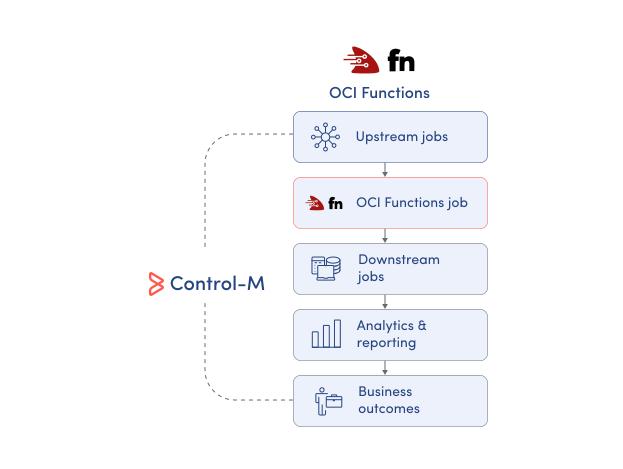
Control-M orchestrates workflows across OCI Functions, OCI Object Storage, OCI Data Integration, OCI Data Flow, file transfers, and enterprise applications in a single job flow — with dependency tracking, SLA visibility, and automated recovery across all of them.
- Cross-tool dependency: OCI Object Storage → OCI Data Integration → OCI Functions → application handoff
- Data-aware triggers: file arrival, API event, upstream job completion, workflow condition
|
OCI Functions |
function invocation · payload parameters · status/results/output monitoring · SLA integration |
|
OCI Object Storage |
file workflow coordination · upstream dependency · downstream processing handoff |
|
OCI Data Integration |
task execution · transformation orchestration · dependency coordination |
|
OCI Data Flow |
Spark workload orchestration · cross-service dependencies · workflow monitoring |
|
Control-M MFT |
managed file transfer · arrival-driven processing · downstream handoff |
|
Enterprise applications |
cross-platform dependencies · scheduled processing · end-to-end workflow coordination |
MONITOR FUNCTIONS
Monitor OCI Functions execution in one workflow view
OCI provides native function metrics and logging, but production workflows often extend beyond the function itself. Control-M monitors OCI Functions status, results, and output alongside surrounding jobs, giving operations teams workflow-level context across the complete service chain:
-
Function execution status
-
Function results and output
-
Upstream and downstream dependencies
-
Cross-platform workflow visibility
-
Centralized production monitoring
SLA ASSURANCE
Protect the SLA beyond the function invocation
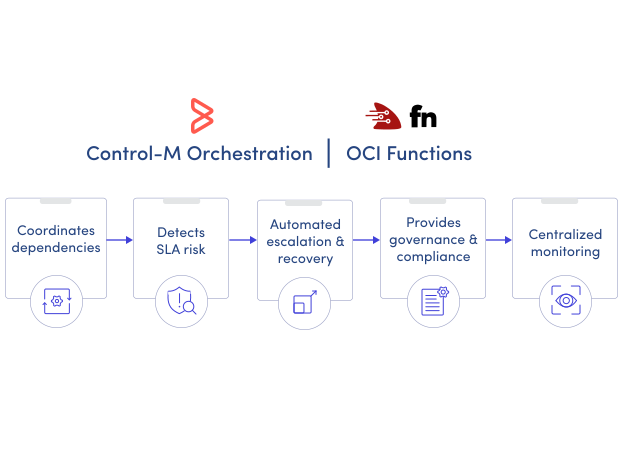
OCI Functions tells you whether serverless code ran; it does not define the business deadline of the entire cross-platform process. Control-M adds SLA management across the surrounding workflow, helping teams identify delays before they become missed service commitments:
-
End-to-end SLA tracking
-
Predictive SLA delay detection
-
Cross-job dependency visibility
-
Automated workflow alerts
-
Business-service deadline visibility
Documentation
Bring order to complex workflows
Learn how Control-M helps teams orchestrate complex processes with greater visibility, coordination, and control.
