Let us know how we can help
Sales & Pricing
Speak to a rep about your business needs

Help & Support
See our product support options
General inquiries and locations
Contact us


 Control-M + Azure DevOps
Your Azure DevOps workflow starts before a pipeline run ever executes — and it can fail when something upstream breaks. An Azure Blob artifact arrives late. A Terraform infrastructure job misses its deployment window. Control-M orchestrates the full chain: artifact arrival, infrastructure provisioning, Azure DevOps pipeline execution, and downstream deployment.
common workflow issues
Does this sound like your week?
UPSTREAM DEPENDENCY
Your Terraform deployment failed. Azure DevOps is still waiting to run.
Control-M evaluates the Terraform job’s completion state before releasing the Azure DevOps pipeline, preventing a deployment against incomplete infrastructure and keeping the dependent workflow from progressing until its prerequisite succeeds.
RELEASE TIMING
The build passed at 2:07 a.m. The downstream batch window didn’t.
Control-M applies advanced scheduling criteria and cross-tool dependencies around the Azure DevOps pipeline, coordinating its completion with downstream jobs and time-sensitive processing windows instead of relying on disconnected schedules.
PIPELINE FAILURE
Your deployment pipeline failed. Three downstream processes are ready to fire.
Control-M monitors Azure DevOps pipeline status and results, holds dependent jobs when the pipeline fails, and prevents the failure from cascading into downstream application, data, or infrastructure workflows.
RELEASE VARIABILITY
Production needs the release branch. Tonight’s run still points elsewhere
Control-M can execute the Azure DevOps pipeline against a specified repository branch and pass pipeline variables and parameters at runtime, keeping release execution aligned with the intended deployment configuration.
SLA RISK
The pipeline is running long. The 6 a.m. service deadline isn’t moving.
Control-M brings the Azure DevOps job into the broader service workflow and attaches SLA management, giving operations teams visibility into deadline risk before a delayed pipeline impacts the end-to-end business service.
INTEGRATION FACTS
Control‑M + Azure DevOps
|
API and automation capabilities |
Automation API · JSON Jobs-as-Code · Azure DevOps pipeline execution · pipeline variables · pipeline parameters · repository branch · stages-to-skip · build-log retrieval |
|
Deployment models & infrastructure flexibility |
Control-M SaaS · self-managed Control-M · Control-M Web · Automation API · Linux Agent · Windows Agent · Azure DevOps endpoints |
|
Security posture |
centralized connection profiles · Personal Access Token authentication · Service Principal authentication · Microsoft Entra tenant ID · application ID · client secret · external vault support (via centralized connection profiles) |
|
Incident response & MTTR enablement |
pipeline status monitoring · results monitoring · build-log visibility · configurable status polling · failure tolerance · downstream dependency control · SLA monitoring · centralized job output |
end-to-end orchestration
One production workflow. Every tool in the stack.
Control-M orchestrates workflows across Azure DevOps, Terraform, Kubernetes, Jenkins, file transfers, and Azure services in a single job flow — with dependency tracking, SLA visibility, and automated recovery across all of them.
- Cross-tool dependency: Terraform → Azure DevOps pipeline → Kubernetes deployment → application handoff
- Data-aware triggers: file arrival, API event, infrastructure completion, upstream job completion
|
Azure DevOps |
pipeline execution · variables and parameters · repository refs · stage control · status and output monitoring |
|
Terraform |
infrastructure workflow orchestration · dependency coordination · execution sequencing |
|
Kubernetes |
workload coordination · downstream dependencies · application workflow orchestration |
|
Jenkins |
pipeline execution · parameterized jobs · status monitoring · cross-tool dependencies |
|
Azure Functions |
function execution · dependency orchestration · downstream workflow coordination |
|
Managed File Transfer |
file arrival detection · secure transfer · workflow triggering · delivery dependencies |
|
Control-M Automation API |
Jobs-as-Code · JSON definitions · CI/CD integration · automated deployment |
MONITOR PIPELINES
Monitor Azure DevOps pipeline execution in one place.
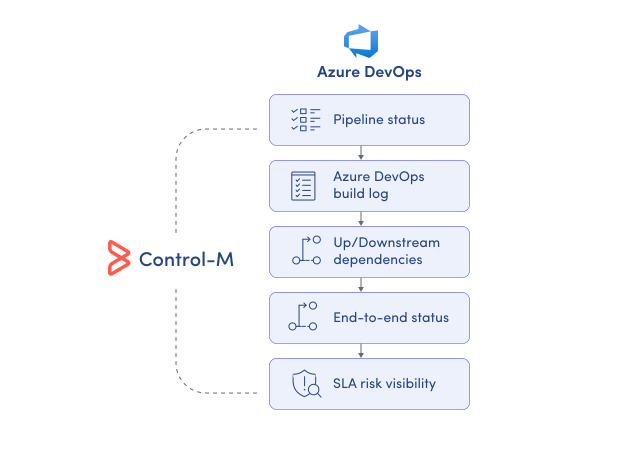
Azure DevOps shows what happens inside its pipeline. Control-M adds the surrounding operational context, so platform and SRE teams can see pipeline execution alongside the jobs and dependencies that determine whether the complete production workflow succeeds:
-
Pipeline status and results
-
Azure DevOps pipeline build log
-
Upstream and downstream dependencies
-
End-to-end workflow status
-
SLA risk visibility
SLA ASSURANCE
Protect delivery SLAs beyond the Azure DevOps pipeline.
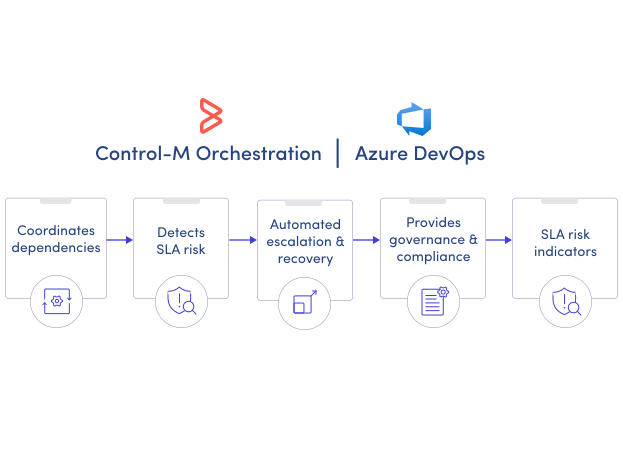
A successful Azure DevOps run does not guarantee the complete service arrived on time. Control-M connects pipeline execution to the broader production workflow and applies SLA management across dependencies, giving teams earlier visibility into delivery risk:
-
End-to-end SLA tracking
-
Cross-tool dependency visibility
-
Delayed workflow identification
-
Centralized execution monitoring
-
Downstream dependency control
