Let us know how we can help
Sales & Pricing
Speak to a rep about your business needs

Help & Support
See our product support options
General inquiries and locations
Contact us


 Control-M + Amazon EC2
Your Amazon EC2 workflow starts before a VM lifecycle operation ever executes — and it can fail when something upstream breaks. An Amazon S3 object never arrives. An AWS Step Functions state machine finishes outside its expected window. Control-M orchestrates the full chain: S3 object arrival, Lambda preprocessing, EC2 VM operation, and downstream application handoff.
common workflow issues
Does this sound like your week?
These aren’t edge cases. They’re the normal operating conditions for teams running Amazon EC2 workflows across multiple tools. Here’s how Control-M handles each one.
UPSTREAM DEPENDENCY
Your S3 object is late. The EC2 instance starts anyway.
Control-M holds the EC2 operation until required upstream conditions are satisfied, then releases it as part of the same workflow. Dependencies replace disconnected schedules, preventing compute from starting before the workload it supports is ready.
API THROTTLING
AWS returns HTTP 429. Your overnight workflow stops there.
Control-M can detect configured HTTP response codes and rerun the EC2 execution step using a defined interval and attempt count. Transient AWS API responses can be retried automatically instead of becoming an immediate manual recovery task.
FLEET OPERATIONS
Twenty tagged instances need to start. Someone is scripting it again.
Control-M can start, stop, or restart EC2 virtual machines by tag, applying the operation to multiple matching instances. Teams coordinate fleet-level lifecycle actions within the production workflow instead of maintaining separate scripts and scheduling logic.
STATE VERIFICATION
The start request succeeded. The instance never reached the expected state.
Control-M verifies EC2 job status using a configurable polling interval and tolerance. If the operation does not reach the required state, the job can end Not OK, making the failure visible before dependent work continues.
SLA RISK
EC2 is running late. The downstream business deadline is approaching.
Control-M brings EC2 jobs into the same scheduling environment as upstream and downstream work and lets teams attach an SLA job. Operators can track the infrastructure operation in context and respond before workflow delays become missed commitments.
INTEGRATION FACTS
Control‑M + Amazon EC2
|
API and automation capabilities |
Control-M Automation API · Job EC2 · ConnectionProfile EC2 · create/start/stop/reboot/delete · tag-based start/stop/restart |
|
Deployment models & infrastructure flexibility |
Control-M SaaS · Control-M self-managed · Linux Agent · Windows Agent · centralized connection profile · any Amazon EC2 |
|
Security posture |
AWS Key & Secret · AWS IAM Role · AWS IAM Assume Role · cross-account authentication · external vault secret retrieval · centralized credential management |
|
Incident response & MTTR enablement |
HTTP-code rerun · configurable rerun interval · configurable attempt count · verification polling · failure tolerance · SLA jobs · job status/results/output monitoring |
end-to-end orchestration
One production workflow. Every tool in the stack.
Control-M orchestrates workflows across Amazon EC2, AWS Step Functions, AWS Lambda, AWS Batch, file transfers, and databases in a single job flow — with dependency tracking, SLA visibility, and automated recovery across all of them.
- Cross-tool dependency: AWS Step Functions → Amazon EC2 operation → AWS Batch → application handoff
- Data-aware triggers: file arrival, API event, upstream job completion, schedule window
|
Amazon EC2 |
create/start/stop/reboot/delete VMs · tag-based start/stop/restart · status and output monitoring |
|
AWS Step Functions |
state-machine execution · cross-tool dependencies · execution monitoring |
|
AWS Lambda |
function invocation · parameterized execution · workflow dependencies |
|
AWS Batch |
batch-job submission · execution monitoring · downstream dependencies |
|
File transfers |
managed transfers · file-arrival dependencies · delivery coordination |
|
Databases |
database job execution · workflow dependencies · downstream handoff |
MONITOR OPERATIONS
See EC2 operations in the full workflow context
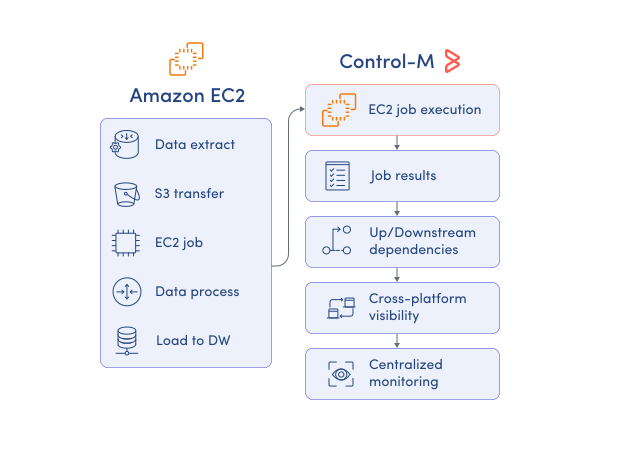
Amazon EC2 shows infrastructure state, but that alone does not show whether the broader production workflow is on track. Control-M centralizes EC2 job status, results, output, and surrounding dependencies so operations teams can follow execution across platforms:
-
EC2 job execution status
-
Job results and output
-
Upstream and downstream dependencies
-
Cross-platform workflow visibility
-
Centralized operational monitoring
SLA ASSURANCE
Keep EC2-dependent workflows aligned to business deadlines
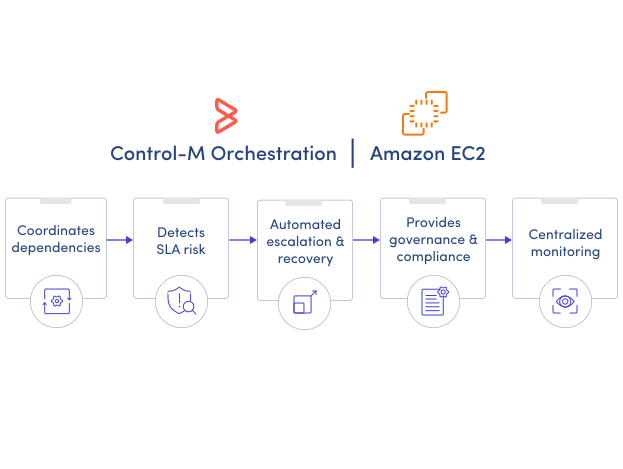
A successful VM operation does not guarantee the end-to-end workflow will finish on time. Control-M connects Amazon EC2 execution to broader scheduling and SLA management, helping teams understand infrastructure delays in the context of the production service they affect:
-
SLA job attachment
-
End-to-end dependency tracking
-
Advanced scheduling criteria
-
Automated failure handling
-
Resource-aware workflow control
Documentation
Bring order to complex workflows
Learn how Control-M helps teams orchestrate complex processes with greater visibility, coordination, and control.
