Let us know how we can help
Sales & Pricing
Speak to a rep about your business needs

Help & Support
See our product support options
General inquiries and locations
Contact us


 Control-M + AWS App Runner
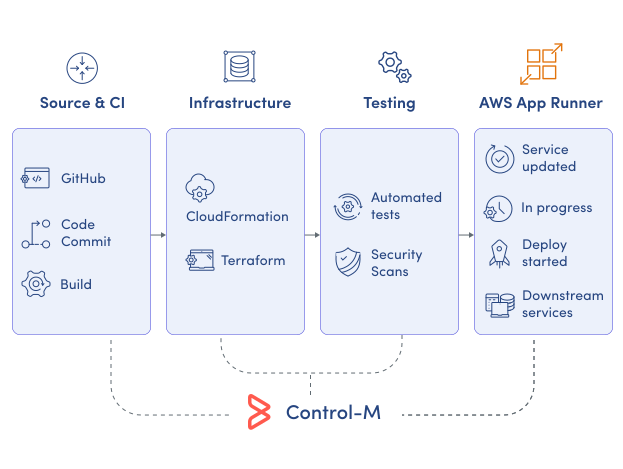
Your AWS App Runner workflow starts before a service deployment ever pulls a container image — and it can fail when something upstream breaks. An Amazon ECR image tag never resolves after a failed push to the target repository. An AWS CodeBuild project exceeds its build timeout before producing a verified image. Control-M orchestrates the full chain: AWS CodeBuild build, Amazon ECR image staging, AWS App Runner execution, and Amazon Route 53 delivery.
common workflow issues
Does this sound like your week?
These aren’t edge cases. They’re the normal operating conditions for teams running AWS App Runner deployments across multiple tools. Here’s how Control‑M handles each one.
DEPLOYMENT BLOCKERS
Your image built successfully. App Runner never received a deploy trigger.
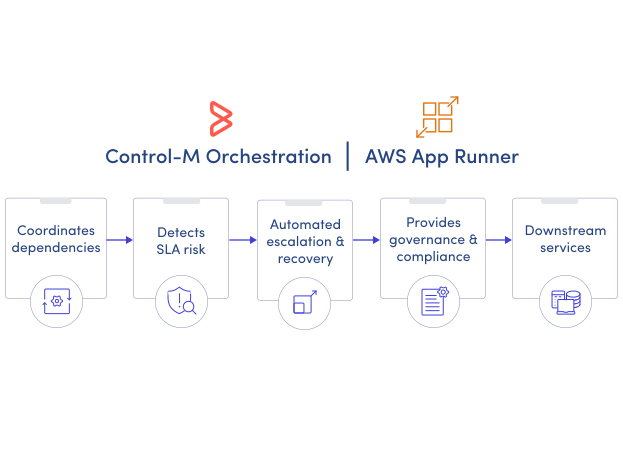
Your CI pipeline finishes, but a failed handoff prevents deployment to AWS App Runner. Control-M detects upstream completion, validates deployment prerequisites, triggers the App Runner deployment, and prevents downstream workflows from starting until the service is successfully updated.
FAILED DEPENDENCIES
Infrastructure provisioning stalled. Your deployment kept waiting.
Infrastructure changes, IAM updates, or supporting cloud services don't finish on schedule. Control-M tracks dependency status across infrastructure and application workflows, automatically delays deployment, retries where appropriate, and resumes only when prerequisites are fully satisfied.
RELEASE COORDINATION
Multiple environments. Different release windows. One missed deployment.
Coordinating deployments across development, staging, and production often requires manual oversight. Control-M orchestrates environment-specific workflows, enforces approval gates and deployment windows, and promotes releases only after every validation completes successfully.
FAILURE RECOVERY
Deployment failed midway. Nobody noticed until users reported it.
Native deployment notifications don't coordinate the broader release process. Control-M monitors deployment outcomes, detects failed execution states, initiates configurable recovery actions, alerts the appropriate teams, and prevents downstream automation from amplifying the failure.
CROSS-TOOL AUTOMATION
Git push succeeded. Five downstream systems still needed manual coordination.
Modern application delivery spans repositories, build systems, container registries, AWS services, testing tools, and IT operations. Control-M orchestrates the entire workflow from code commit through deployment, validation, notification, and post-deployment automation in a single end-to-end process.
INTEGRATION FACTS
Control‑M + AWS App Runner
|
API and automation capabilities |
AWS App Runner API · AWS CLI · AWS SDKs · source code and container image deployment · CloudFormation · REST API integration |
|
Deployment models & infrastructure flexibility |
Fully managed serverless containers · source repository deployment · Amazon ECR image deployment · automatic deployments · multi-environment workflows · AWS cloud-native integration |
|
Security posture |
IAM role-based access control · IAM service roles · AWS Assume IAM Role cross-account authentication · encrypted in transit · audit logging · role-based access control (RBAC) · SAML/SSO |
|
Incident response & MTTR enablement |
Automated deployment retry with configurable logic · deployment status monitoring · dependency-based workflow control · Amazon SNS alert integration · PagerDuty integration · automated rollback workflows |
end-to-end orchestration
One production workflow. Every tool in the stack.
Control-M orchestrates workflows across AWS App Runner, Amazon ECR, GitHub Actions, Jenkins, Terraform, AWS Lambda, and cloud services in a single job flow—with dependency tracking, SLA visibility, and automated recovery across all of them.
- Cross-tool dependency: Git commit → CI build → Amazon ECR image → AWS App Runner deployment → validation tests → production release
- Data-aware triggers: Git push, container image published, API event, infrastructure completion, deployment status
|
AWS App Runner |
Deploy services · monitor deployment status · orchestrate release workflows · trigger downstream automation |
|
Amazon ECR |
Detect new container images · validate image availability · trigger deployment pipelines · manage dependencies |
|
GitHub Actions |
Trigger deployment workflows · coordinate CI pipeline approvals · synchronize release pipelines |
|
Jenkins |
Launch CI jobs · monitor build completion · capture exit status · control downstream execution |
|
Terraform |
Orchestrate infrastructure provisioning · validate completion · enforce deployment dependencies |
|
AWS Lambda |
Execute event-driven tasks · automate validation and remediation · integrate serverless workflows |
|
Amazon SNS |
Trigger operational alerts · notify teams on deployment events · coordinate automated recovery workflows · integrate with incident management platforms |
MONITOR DEPLOYMENTS
Monitor AWS App Runner deployments from a single operational view.
AWS App Runner provides service-level deployment information, but production workflows extend across CI/CD pipelines, infrastructure provisioning, testing, and cloud services. Control-M delivers centralized visibility into every dependency and execution stage from one operational dashboard, including:
-
End-to-end workflow status
-
Deployment execution history
-
Cross-platform dependency tracking
-
SLA monitoring and alerts
-
Automated failure notifications
Control-M Monitoring dashboard displaying an AWS App Runner deployment with upstream GitHub, Jenkins, Amazon ECR, Terraform, and downstream validation jobs, highlighting workflow status, dependencies, and SLA indicators.
RELIABLE RELEASES
Deploy AWS App Runner services with confidence and control.
Application deployments often depend on successful infrastructure provisioning, security validation, image publishing, and approval workflows. Control-M orchestrates every prerequisite, automates recovery when failures occur, and ensures deployments progress only when the entire release workflow is ready, including:
-
Automated dependency validation
-
Configurable retry policies
-
Release approval gates
-
Intelligent workflow recovery
-
Cross-team operational visibility
An end-to-end workflow diagram illustrating a deployment pipeline from GitHub to Jenkins, Amazon ECR, AWS App Runner, validation testing, notifications, and production release, with Control-M orchestrating dependencies and recovery across every stage.
Documentation
Bring order to complex workflows
Learn how Control-M helps teams orchestrate complex processes with greater visibility, coordination, and control.
