Let us know how we can help
Sales & Pricing
Speak to a rep about your business needs

Help & Support
See our product support options
General inquiries and locations
Contact us


 Control-M + Atlassian Bitbucket
Your Bitbucket workflow starts before a CI/CD pipeline ever runs — and it can fail when something upstream breaks. A build artifact is missing from JFrog Artifactory. A Jenkins build job misses its expected completion window. Control-M orchestrates the full chain: artifact arrival, build preparation, pipeline execution, and production delivery.
common workflow issues
Does this sound like your week?
PIPELINE BLOCKERS
The commit merged. The deployment never started.
A Bitbucket merge completes successfully, but an external validation job never reports status. Control-M tracks upstream dependencies across tools, validates completion states, and automatically launches the next stage only when required conditions are met.
FAILED HANDOFFS
Jenkins finished at 2:03 AM. Nobody knew.
A downstream deployment depends on a completed build, but the handoff never occurs. Control-M detects exit states, manages cross-platform dependencies, and triggers downstream workflows automatically without manual intervention or polling scripts.
RELEASE GOVERNANCE
Production approval arrived. The release window was missed.
Approvals often happen outside predefined execution windows. Control-M combines approval status, scheduling rules, and deployment dependencies to automatically execute releases when governance requirements and operational constraints are satisfied.
INCIDENT RECOVERY
One container deployment failed. Everything else kept running
Control-M isolates failures, prevents cascading downstream execution, and applies configurable recovery actions. Teams can restart only affected workflow components, reducing recovery time and avoiding unnecessary reruns across the pipeline.
MULTI-TOOL VISIBILITY
The outage started upstream. Bitbucket got the blame.
When workflows span repositories, CI servers, cloud services, and Kubernetes clusters, root cause identification becomes difficult. Control-M provides end-to-end visibility, dependency tracking, and execution context across the entire delivery chain.
Control‑M + Atlassian Bitbucket
Control‑M + Atlassian Bitbucket
|
API and automation capabilities |
REST API · Pipeline Actions trigger · pull request lifecycle automation · pipeline status monitoring · manual JSON payload · API token authentication · username (email) identifier · API-driven workflow triggers |
|
Deployment models & infrastructure flexibility |
Bitbucket Cloud · SaaS · hybrid infrastructure · container-based delivery pipelines |
|
Security posture |
RBAC · API token authentication · CyberArk vault integration · HashiCorp vault integration · encrypted-in-transit · audit logging · repository permissions |
|
Incident response & MTTR enablement |
automated retry policies · dependency-aware recovery · workflow restart from failure point · SLA breach alerting · PagerDuty integration · ServiceNow integration · notification routing |
end-to-end orchestration
One production workflow. Every tool in the stack.
Control-M orchestrates workflows across Atlassian Bitbucket, Jenkins, Kubernetes, Terraform, cloud services, security scanning platforms, and deployment tools in a single job flow — with dependency tracking, SLA visibility, and automated recovery across all of them.
- Cross-tool dependency: Bitbucket commit → Jenkins build → security scan → Kubernetes deployment
- Data-aware triggers: pipeline completion status, pull request approval, build completion, API response
|
Bitbucket |
pipeline execution · pull request lifecycle management · pipeline status monitoring · Manual JSON payload execution |
|
Jenkins |
build execution · status tracking · downstream orchestratio |
|
Kubernetes |
deployment automation · rollout monitoring · recovery actions |
|
AWS CloudFormation |
infrastructure provisioning · stack dependency validation · environment readiness |
|
Azure DevOps |
pipeline gating · code quality enforcement · release validation |
|
AWS |
cloud resource orchestration · deployment coordination · event-driven automation |
|
PagerDuty |
deployment failure alerting · on-call escalation · incident notification |
MONITOR DELIVERY
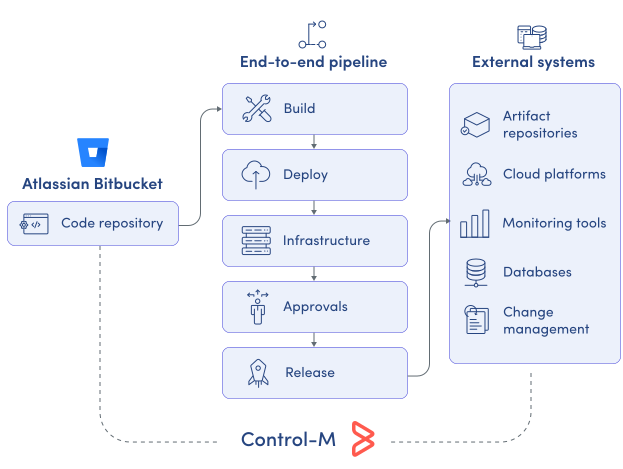
Monitor Bitbucket-driven releases across the entire pipeline
Bitbucket provides repository and pipeline visibility, but not end-to-end workflow context across external systems. Control-M delivers centralized monitoring across builds, deployments, infrastructure changes, and approvals so teams can quickly identify risks and bottlenecks:
-
Pipeline execution status
-
Cross-tool dependency view
-
Runtime trend analysis
-
Centralized failure tracking
-
Release progress visibility
SLA ASSURANCE
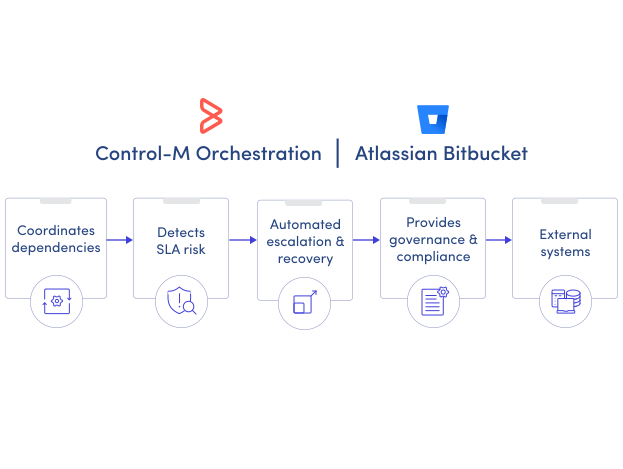
Keep release commitments on schedule
Bitbucket tracks repository activity but does not manage enterprise-wide release SLAs. Control-M monitors workflow timing, predicts SLA risks, and initiates automated recovery actions before delivery deadlines are missed:
-
SLA breach prediction
-
Automated escalation paths
-
Dependency-aware scheduling
-
Recovery workflow automation
-
Release window enforcement
