Let us know how we can help
Sales & Pricing
Speak to a rep about your business needs

Help & Support
See our product support options
General inquiries and locations
Contact us


AI Workflow Orchestration—Best Approaches for Running AI Reliably in Production
Ensure AI workflows and AI agents execute reliably at scale across hybrid, multi-cloud, and on-prem systems
What AI Workflow Orchestration Means in Production
AI workflow orchestration acts as the control system for complex AI environments, coordinating data pipelines, model execution, dependencies, triggers, and error handling to ensure reliable operations.
Running AI in production can be like managing air traffic in unpredictable skies. Data arrives continuously, some systems act autonomously, and models trigger in real time—requiring precise coordination to avoid delays or failures.
As AI systems evolve, approaches like agentic orchestration are introducing autonomous decision-making, which makes reliable execution even more critical.
AI Workflow Orchestration vs. Agentic Orchestration
While closely related, AI workflow orchestration and agentic orchestration address different, but complementary, needs in production environments:
| Capability | AI Workflow Orchestration | Agentic Orchestration |
|---|---|---|
| Primary focus | Reliable execution of workflows | Autonomous decision-making and actions |
| What it manages | Data pipelines, model execution, system dependencies | AI agents that plan, reason, and take action |
| Strength | Predictability, control, and scalability | Adaptability and dynamic behavior |
| Challenge it solves | Ensuring AI runs correctly every time | Enabling AI to respond intelligently to changing conditions |
In production, these approaches work together:
- AI agents decide what actions to take
- Workflow orchestration ensures those actions execute reliably
For example: An AI agent detects a potential fraud pattern and initiates an investigation. AI workflow orchestration ensures the required data is available, models execute correctly, and downstream actions occur in the right order and within SLA. Without orchestration, AI agents can become unpredictable and difficult to control. Without agentic capabilities, workflows remain rigid and unable to adapt. Together, they enable AI systems that are both adaptive and reliable in production
Agents decide. Guardrails make sure they act safely. Learn how in our guide to execution guardrails for AI agents.

How AI Workflow Orchestration Helps Run AI Reliably in Production
Example: Real-Time Fraud Detection A bank evaluates every transaction instantly. Each transaction triggers a sequence: data ingestion, validation, enrichment, model scoring, and decisioning.
AI workflow orchestration helps to ensure reliability by:
Coordinating end-to-end workflow
Connects transaction, data pipelines, AI model, and decision systems into a single managed flow.
Managing dependencies
Fraud models run only when all required data (history, geolocation, risk signals) is validated, preventing errors.
Enabling real-time execution
Workflows trigger instantly on each transaction, scoring in milliseconds for immediate decisions.
Handling failures automatically
Retries, fallback logic, or alternate paths prevent transaction failures or customer friction.
Providing full visibility and SLA control
Operations teams monitor every step, ensuring decisions meet strict timing thresholds.
What to Look for in AI Workflow Orchestration Solutions
If you’re evaluating solutions to help run AI reliably in production, focus on these capabilities:
| Requirement | Why It Matters |
|---|---|
| End-to-end visibility | See the full workflow chain |
| Dependency management | Prevent cascading failure |
| Event-driven orchestration | Handle real-time execution |
| Hybrid/multi-cloud support | Run anywhere |
| SLA management | Ensure business reliability |
| AI-assisted operations | Predict and resolve issues |
| Agent-aware orchestration | Coordinate workflows triggered by AI agents via open, governed protocols |
| AI workflow control & compliance | Enforce policies, track actions, and provide audit trails to ensure safe, auditable AI operations |
Go deeper
Execution Guardrails for AI Agents — Set limits on what AI agents can do, before they do it.
Policy-Controlled Orchestration — Enforce governance rules at runtime, on every run.
Audit Trail & Lineage — Track what ran, when, why, and under which policy.
Why Traditional Tools Fall Short for AI in Production
Most tools solve part of the problem—not the full system required to run AI reliably.
| Tool Type | What It Solves | Why It Falls Short for AI |
|---|---|---|
| CI/CD | Code deployment | Does not manage runtime workflows |
| Job schedulers | Task execution | Lacks cross-system orchestration |
| Data pipelines | Data movement | Does not coordinate end-to-end processes |
| ITSM | Incident management | Reactive, not real-time |
| AI agent frameworks | Agent logic and decision-making | Do not ensure reliable execution across enterprise systems |
Core Use Cases for AI Workflow Orchestration
AI workflow orchestration enables reliable execution across high-impact production scenarios:
Real-Time Decisioning
Coordinate data ingestion, model scoring, and decisions in milliseconds.
End-to-End AI Pipelines
Orchestrate workflows from data preparation to execution to downstream actions.
Continuous Model Operations (MLOps)
Automate retraining, validation, and deployment to maintain accuracy.
AI Agent Orchestration
Trigger and coordinate AI agents across workflows while enforcing policies and tracking actions for auditable outcomes.
AI Compliance and Control
Ensure AI workflows adhere to internal policies and external regulations. Automate audit logging, enforce role-based controls, and provide traceability for AI-driven decisions, supporting accountability and explainability.
Compliance works best when it is built into every run, not checked afterward. See how with policy-controlled orchestration.
The New Foundations for AI-Driven Operations with Control-M
Control-M’s workflow orchestration enables teams to design, execute, and govern AI workflows reliably in production—reducing risk while ensuring SLA-driven, compliant outcomes.
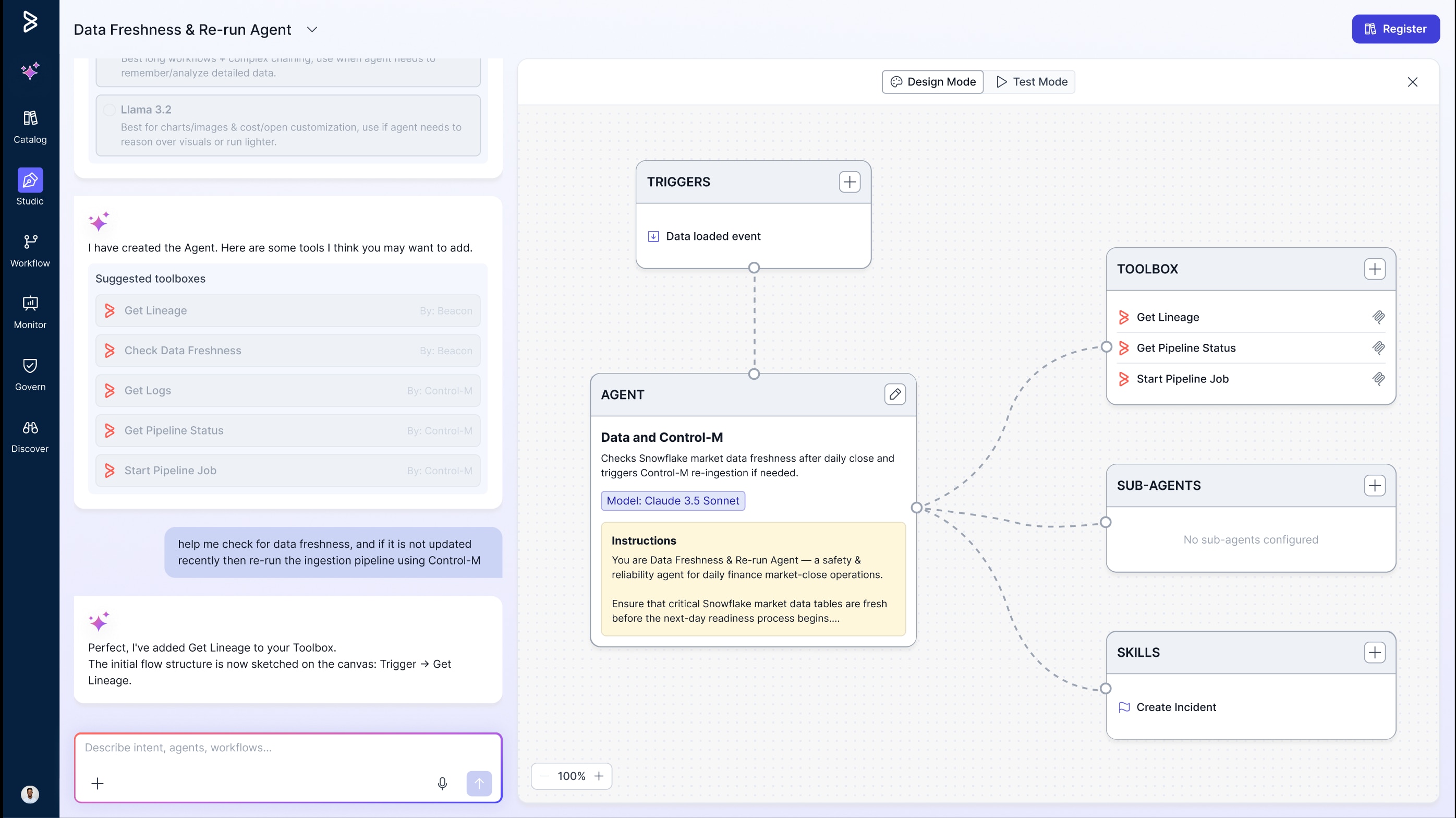
Build smarter.
Design AI and enterprise workflows in minutes using natural language, with full visibility into dependencies and execution paths.
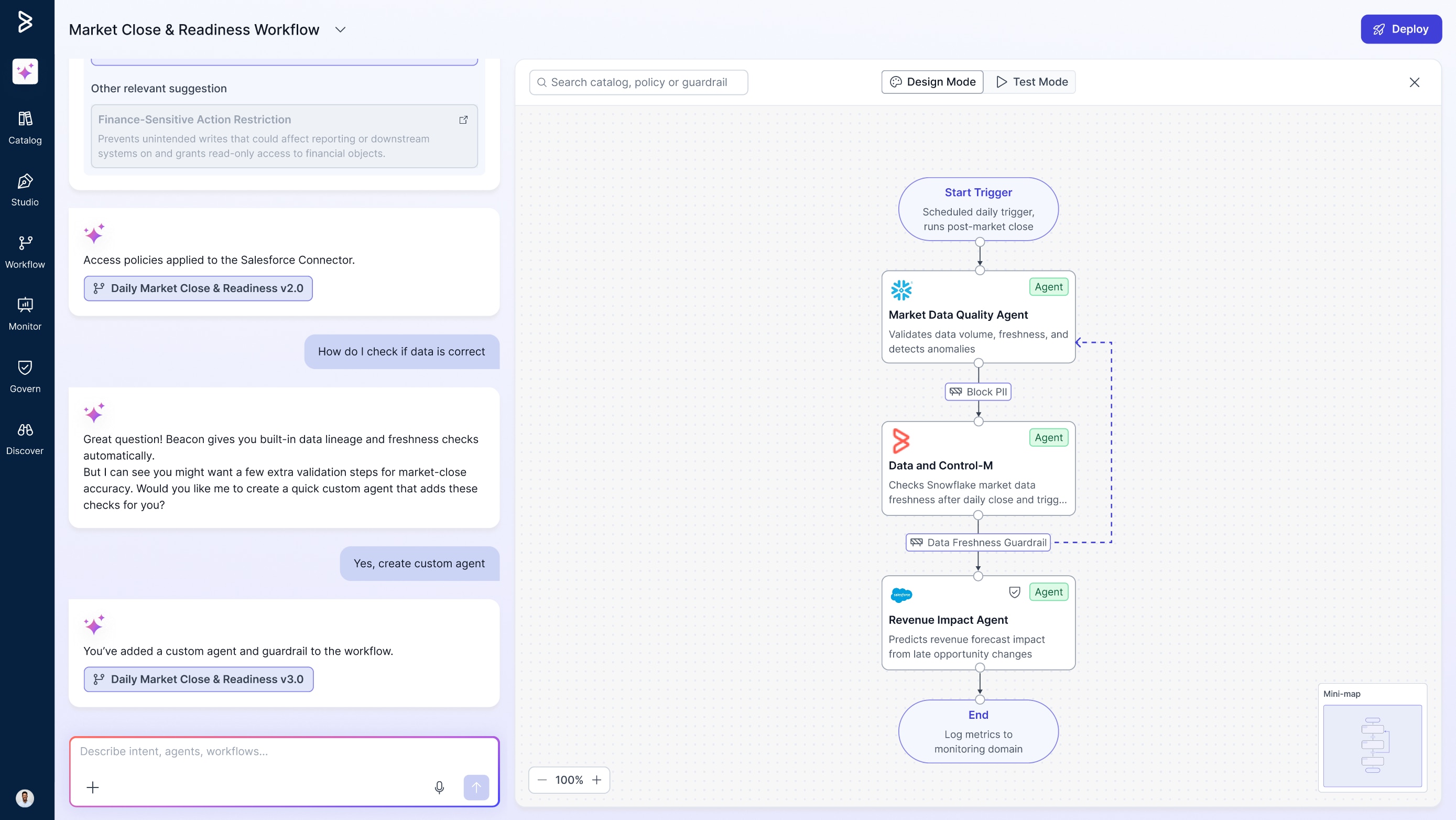
Run stronger.
Ensure uptime and reliability with event-based triggering, predictive insights, and automated recovery before issues impact business outcomes.
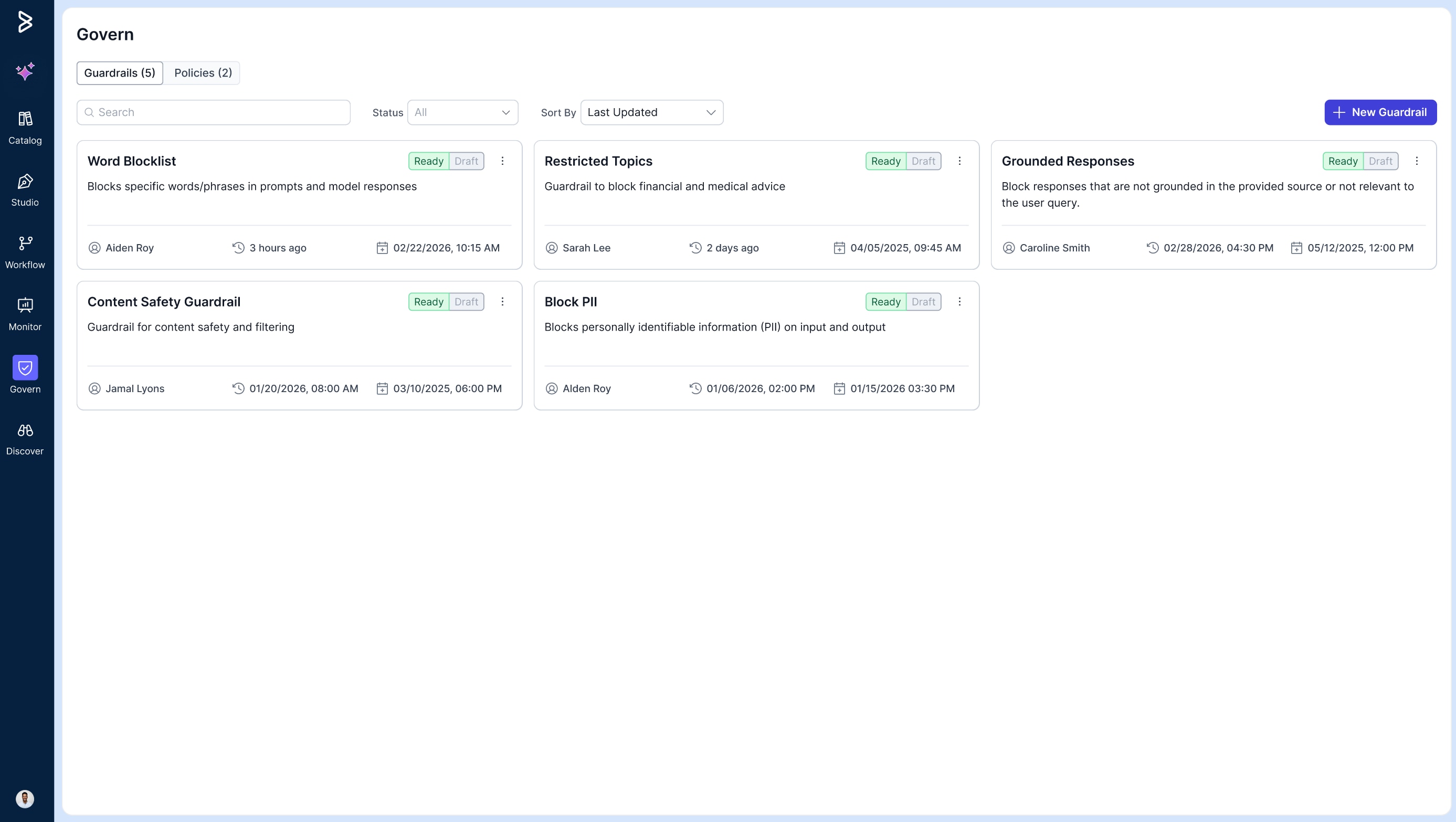
Manage continuously.
Automate AI governance, enforce policies at runtime, and maintain full auditability across workflows and AI agents.
What This Looks Like in Production
Control-M acts as the command center for enterprise AI workflows and AI agents, enabling teams to manage, monitor, and scale execution reliably.
-
Single view of the whole AI workflow See every step—from data ingestion to model output—in one place, with status and dependencies clearly mapped.
-
Real-time workflow triggering Start workflows instantly based on live events (e.g., a transaction or data update)
-
SLA monitoring dashboard Track whether AI processes are meeting timing expectations, with alerts before issues impact the business.
-
Automated failure handling Detect, retry, and reroute without manual intervention
How Control-M Is Different
Control-M brings together AI workflows and AI agents in one platform—simplifying, automating, and keeping operations governed and traceable at scale.
| Capability | What’s Different | Impact |
|---|---|---|
| End-to-end orchestration | One platform across all system | No gaps or handoffs |
| Event-driven execution | Runs in real time | Supports instant decisions |
| Full visibility | Single view of all workflows | Faster troubleshooting |
| SLA management | Built-in tracking and notificationsBuilt-in tracking and notifications | Consistent outcome |
| Automated recovery | Automatically handles failures | Less downtime |
| Hybrid support | Works across on-prem, cloud, and hybrid environments | No environment limits |
| Agent-aware orchestration | Coordinates workflows triggered by AI agents | Reliable execution of agent-driven action |
| AI workflow oversight | Enforces policies, tracks actions, and provides audit trails | Compliant and auditable AI workflow execution |
| Agent integration | Model Context Protocol (MCP): dynamic discovery | Al innovation without operational |
Control-M FAQs for Running AI Reliably in Production
Does Control-M integrate with tools like Databricks, SageMaker, Azure ML, and Dataiku?

How does Control-M provide visibility into AI workflow performance and SLA compliance?
Can Control-M automatically handle failures or exceptions in AI workflows?
How does Control-M scale AI workflows as volume or complexity increases?
Does Control-M support event-driven AI workflows for real-time decisioning?
How do AI agents interact with Control-M?
Control-M FAQs for Running AI Reliably in Production
Does Control-M integrate with tools like Databricks, SageMaker, Azure ML, and Dataiku?
How does Control-M provide visibility into AI workflow performance and SLA compliance?
Can Control-M automatically handle failures or exceptions in AI workflows?
How does Control-M scale AI workflows as volume or complexity increases?
Does Control-M support event-driven AI workflows for real-time decisioning?
How do AI agents interact with Control-M?
Practical Guides for Running AI Reliably in Production
Audit Trail & Lineage
Track what ran, when, why, and under which policy.
Learn more
Policy-Controlled Orchestration
Enforce governance rules at runtime, on every run.
Learn more
Data Orchestration vs. Workflow Orchestration
Know when you need data orchestration, workflow orchestration, or both.
Learn more
