Let us know how we can help
Sales & Pricing
Speak to a rep about your business needs

Help & Support
See our product support options
General inquiries and locations
Contact us


Execution Guardrails for AI Agents
Implementing AI Agent Guardrails for Production AI
The problem isn't agent decisions. It's agent access to execution.
This isn’t about making agents safer in the usual sense.
AI agent risk has two layers:
- Decision risk: Did the agent choose the right action?
- Execution risk: Was the agent allowed to execute it?
This guide focuses on execution risk. It isn’t about prompt engineering, model alignment, or output filtering. Those controls matter, but the most serious operational incidents begin when an agent is allowed to execute an action that shouldn't have run.
Once an agent can trigger workflows, initiate jobs, modify systems, or orchestrate downstream processes, the question you need to ask is: “What’s allowed to execute, under what conditions, and where is that control enforced?”
The moment an AI agent can take action, access becomes an execution control problem. That's where execution guardrails come in.
Quick take: Agent decisions create intent. Agent access creates exposure. Execution control determines what’s allowed to run.
Where Execution Guardrails Belong (In Front of Execution)
Execution guardrails are controls that determine whether an AI agent’s requested action is allowed to run in production. Before anything executes, those controls check identity, scope, approvals, dependencies, timing, and operational policy across a workflow, job, API-driven step, or system change.
These controls belong between agent intent and execution, not inside the agent itself. They don’t determine what the agent decides to request. They determine what’s allowed to run. In practice, that means routing agent-initiated execution through a control plane—the centralized point where execution requests are evaluated against policy before downstream work begins.
Without a consistent enforcement point, downstream systems are left to apply their own rules, or no rules at all, which creates opportunities for unauthorized actions, inconsistent approvals, and policy drift.
But before a system can evaluate an execution request, it first has to answer a basic question: Who, or what, is making the request?
How an AI Agent Gets Authorized to Execute Anything
Execution control starts with identity. Without a distinct, controlled, and attributable identity, an agent's requests can't be evaluated against policy, tied to approved permissions, or traced through execution history.
One of the quickest ways to weaken execution control is to rely on shared credentials. When multiple agents use the same accounts, API keys, or service identities, it’s difficult to determine who initiated an action, what permissions were intended, and whether access was appropriately scoped.
To authorize agent-driven execution safely, identity and permissions should be governed, attributable, and constrained.
- Execution requests should use controlled, auditable service identities
Agent-driven actions should run through approved service identities rather than shared credentials or human accounts. - Permissions should be scoped to specific approved work
Access should be limited to authorized jobs, workflows, services, and environments based on defined roles and policies. - Every request should be attributable
Execution requests should be traceable to a specific identity and permission set for authorization, auditing, and operational visibility. - Execution rights should come from orchestration policy and RBAC
What an agent can execute should be determined by approved orchestration policy and role-based access controls, not implicitly inherited from application code. - Anonymous or shared execution paths should be avoided
Execution shouldn’t depend on generic credentials that make ownership, accountability, or access boundaries difficult to establish.
What this looks like in production
Agents submit execution requests through a control plane using approved identities and permissions. Access is scoped to authorized workflows and services, and execution requests are evaluated against established policies before work proceeds.
As a result, actions remain attributable, access stays within defined boundaries, and execution governance can be applied consistently.
Quick take: Identity controls access to execution paths. No agent should execute anything without a distinct identity, approved permissions, and policy-based execution control.
How to Intercept an AI Agent Before It Executes Anything
Identity tells you who's making the request. Interception turns that authorization into enforcement.
In production, agents should submit execution requests through a controlled interface—for example, an MCP-based interface such as the Control-M MCP Server—rather than calling scripts, jobs, or operational APIs directly.
That interface routes requests for orchestrated workloads to the control plane, where they can be evaluated against policy before approved work proceeds. This is different from trying to govern every arbitrary API an agent might be able to reach. The goal is to intercept and control the execution paths that matter most: the workflows, jobs, and downstream operational processes routed through the control plane.
Practically, enforcement looks like this:
- Agent plans an action
- Agent generates an execution request
- The request is submitted through a controlled interface
- The control plane intercepts the request and evaluates policies such as identity, scope, approval, timing, and prerequisites
- The control plane allows, pauses, or denies execution
- Authorized systems execute the approved work
- Systems log and return outcomes
Every controlled execution request should follow this path, allowing policies to be enforced consistently rather than relying on individual tools, workflows, or applications to apply their own controls independently.
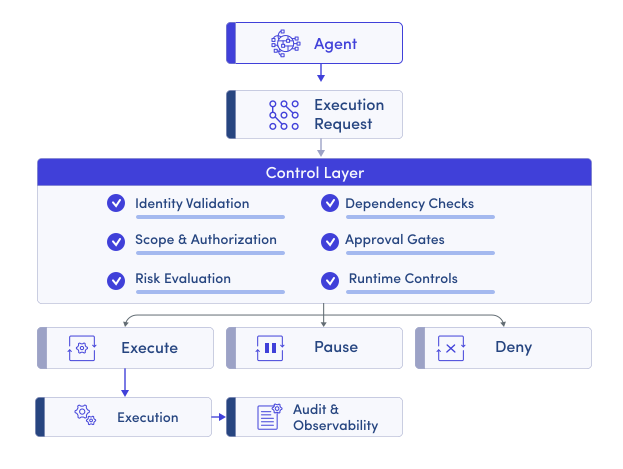
Quick take: Interception only works when agent-initiated execution is routed through a common control plane. The more execution paths that bypass that control plane, the harder consistent enforcement becomes.
8 Execution Guardrails: What Must Be Enforced
Interception is the checkpoint. The eight guardrails below define what needs to be evaluated before an action can run. If any one of them is missing, agents can find a path around policy, approvals, or operational safeguards.
| Guardrail | Question | What to Control | Why it Matters |
|---|---|---|---|
|
Identity |
Who's executing this? |
Governed execution identities, scoped permissions, and no anonymous execution |
Each action can be tied back to a specific identity and permission set |
|
Scope |
What's the agent allowed to touch? |
Approved jobs, workflows, environments, and executable assets |
Agents stay within defined boundaries instead of drifting into unintended systems or workflows |
|
Delegation |
Can permissions expand through handoffs? |
Authorization context, policy checks, and routing for consequential downstream actions |
Permissions are less likely to expand unexpectedly as work moves between agents or services, especially when each consequential action is routed the control plane for independent evaluation |
|
Approval |
Which actions require human sign-off? |
Workflow-enforced approval gates for sensitive or high-impact actions |
Critical actions can be paused for review before execution. If interactive approval is part of the experience, the exact elicitation pattern may depend on the client or interface used to submit the request |
|
Rate, Timing & SLA |
Does execution exceed safe limits or violate operating constraints? |
Workload throttling, concurrency controls, execution windows, retry limits, and SLA-aware scheduling |
Helps prevent retry storms, runaway execution, resource contention, and avoidable SLA risk |
|
Readiness |
Should this run at all? |
Dependencies, data availability, and execution prerequisites |
Work runs only when required conditions have been met |
|
Rollback & Recovery |
How do you recover safely when an AI-triggered action fails? |
Recovery workflows, retries, and compensating actions |
Failures are more likely to remain contained and recoverable rather than cascading across systems |
|
Traceability |
Can you prove what happened? |
Logs, approvals, execution history, and workflow lineage |
Teams can reconstruct what happened, how it happened, and why |
Quick take: Execution guardrails determine how far trust extends.
5 Signs Your AI Agent Architecture Won't Survive Production
If any of these sound familiar, you're likely dealing with an execution control problem, not an AI problem.
01
Agents can call production systems directly
Warning signs:
- Agents call production APIs directly
- Execution decisions live in prompts or application code
- Multiple paths exist to trigger the same action
What it means: Execution is based on implementation, not policy.
02
Shared credentials are doing the heavy lifting
Warning signs:
- Generic service accounts
- Long-lived credentials
- No agent-specific identities
- Limited attribution during investigations
What it means: Access is difficult to control and actions become difficult to trace.
03
Approval exists in process documentation, not enforcement
Warning signs:
- Teams are expected to follow approval procedures manually
- Approval is handled through email, chat, or tickets
- High-risk actions can still execute if someone forgets a step
What it means: Control depends on people remembering the process instead of the system enforcing it.
04
Retry logic lives inside the agent
Warning signs:
- Agent frameworks control retries
- No centralized retry or concurrency controls
- No execution throttling
- Failures generate repeated execution attempts
What it means: Small failures can escalate into resource contention, workflow storms, and operational incidents.
05
You can monitor actions, but you can't prevent them
Warning signs:
- You receive alerts after execution occurs
- Audit trails exist, but pre-execution enforcement does not
- Teams discover problems through dashboards instead of policy checks
What it means: The system can explain what happened after the fact, but it can't stop unsafe actions before they run.
Quick take: If you recognize even one of these patterns, execution decisions are likely happening in code, processes, or individual tools rather than through a centralized control plane.
Why Execution Control Gets Hard in Production
It’s relatively easy to define execution policies. The challenge is ensuring they're enforced everywhere work can run. As environments grow, execution spreads across more systems, services, and automation tools, and not all of them are governed the same way.
That's where control starts to fall apart:
- Agents discover execution paths you didn't anticipate
- Actions bypass approved orchestration channels
- Identity, approval, and policy checks aren't applied consistently
- Different systems enforce different rules
- New automation gets deployed faster than governance can keep up
Guaranteeing that every execution path is subject to the same controls becomes even more difficult when execution is distributed across multiple coordinating agents.
Quick take: The risk isn't that policies are missing. It's that an execution path finds a way around them.
What Changes in Multi-Agent Systems
In a single-agent model, execution is relatively straightforward: an agent submits a request, the request is evaluated, and a decision is made.
In multi-agent systems, agents may delegate work, exchange context, and trigger downstream actions, turning a single execution decision into a chain of execution decisions. As a result:
- Access can expand through delegation
- Attribution becomes harder to trace
- Approval boundaries may not survive handoffs
- Execution volume can increase unexpectedly through coordination
The controls stay the same
Multi-agent systems don’t require new guardrails. They require the same guardrails to be applied consistently at each consequential execution step.
In practice, that means routing downstream actions back through the execution control plane for independent evaluation. Trust established at one step can’t be assumed to carry forward automatically.
What this looks like when it's working
Execution remains controlled even as coordination increases. Permissions stay bounded, approvals apply where risk exists, and every action remains attributable as it flows through the control plane.
Quick take: Multi-agent systems don't require new controls. They require existing controls to survive every handoff, delegation, and downstream action.
Why Most AI Guardrail Strategies Fail
Many teams start with AI guardrails, but they're often applied to agent behavior rather than execution.
Common examples include:
- Prompt guardrails — help shape behavior, but don't determine whether an action is allowed to run. An agent can still generate a valid request for an action that should never execute.
- Direct API access — bypasses the execution checkpoint entirely. Decisions are enforced in code instead of through centralized policy.
- All-or-nothing autonomy — treats every action as equally trusted or untrusted, regardless of risk. Teams are forced to choose between locking everything down and trusting too much.
- Shadow orchestration — pushes execution logic into agent frameworks, custom code, and disconnected tools. You end up with tool sprawl, weak controls, and war-room troubleshooting.
Each approach tries to influence what the agent does. None guarantees control over what the agent is allowed to execute.
Quick take: Influencing what an agent intends to do isn’t the same as controlling what it’s allowed to do.
The Path from Agent Access to Agent Control
Teams don't move directly from AI pilots to production-ready autonomous agents. They move from giving agents access to establishing control over what that access can execute.
Use the model below to see where your architecture stands.
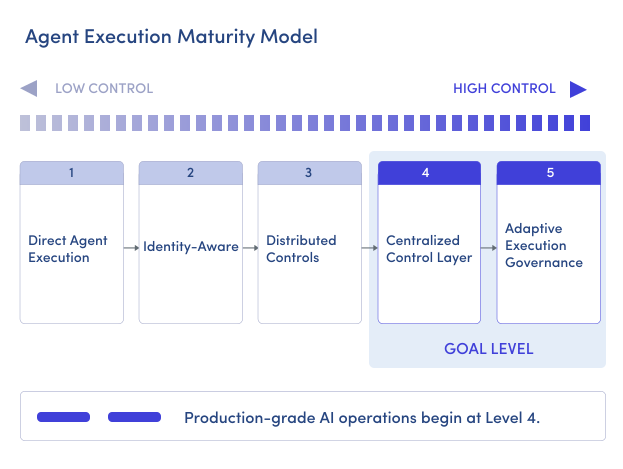
Level 1
Direct Agent Execution
- Agents call APIs directly
- No centralized enforcement
- Decisions made in code
- Execution Risk: Very High
Level 2
Identity-Aware
- Agent identity exists
- Basic authorization
- Limited visibility
- Execution Risk: High
Level 3
Distributed Controls
- Some approvals
- Some policy enforcement
- Controls spread across tools
- Execution Risk: Medium
Level 4
Centralized Control Plane
- Orchestrated execution is intercepted
- Requests route through a common control plane
- Consistent policy enforcement
- Execution Risk: Low
Level 5
Controlled Execution at Scale
- Multi-agent execution is controlled consistently
- Coordinated policy enforcement across orchestrated workflows
- Execution governance scales across teams and systems
- Execution risk: Lowest
Most organizations experimenting with AI agents operate between Level 1 and Level 3. Production-ready AI operations typically begin at Level 4, where orchestrated execution is intercepted through a common control plane. The transition from Level 3 to Level 4 is where many AI initiatives move from experimentation to production-scale execution control.
Execution Guardrails: With and Without
Let’s explore a real-world scenario to bring it all together.
It’s month-end close. A financial reconciliation workflow failed because an upstream data feed arrived late and the required transaction data is incomplete. An AI operations agent is tasked with investigating failed jobs and restoring stalled workflows automatically.
The agent decides the reconciliation process should be rerun and generates an execution request. What happens next depends on whether or not execution guardrails exist.
Without Execution Guardrails
The agent reruns the workflow directly:
- Selects the production workflow instead of the test environment
- Retries execution without verifying whether the upstream data feed has successfully completed
- Repeats execution attempts after multiple failures based on the assumption that the failure was due to a temporary issue
- Triggers downstream reporting and settlement processes using incomplete data
Result: What started as a delayed data feed becomes a broader operational incident. Reconciliation results are inaccurate because required transactions weren’t available when processing occurred. Invalid outputs propagate across dependent systems, teams have to manually identify and correct downstream impacts, and recovery is significantly more complex than the original problem.
With Execution Guardrails
The same execution request is intercepted before anything runs:
- Scope controls prevent access to production workflows
- Dependency validation detects that critical reconciliation data is still missing
- Retry policies prevent repeated execution attempts when prerequisite conditions haven’t been met
- Approval policies pause actions affecting financial reporting until a designated approver signs off
Result: The workflow doesn’t execute under unsafe conditions. The issue is contained at the point of execution, preventing downstream reporting errors while preserving a clear, controlled path to recovery.
Can You Enforce It All in One Place?
Yes, if high-impact actions with downstream consequences are routed through a common control plane. The more execution paths flow through that control plane, the more consistently guardrails can be enforced.
At this point, an obvious question comes up: "If I already have an API gateway or service mesh, don't I already have a control plane?"
Why an API Gateway or Service Mesh Isn’t Enough
Most environments have API gateways, IAM systems, rate limiting, and service mesh controls. Those controls are important. They're just solving a different problem.
API gateways and service mesh answer the question: “Can this request reach this service?” Execution controls answer a different question: “Should this action run at all?”
They don’t control execution
API gateways and service mesh aren't designed to evaluate whether a workflow, job, or operational action should execute based on dependencies, approvals, business risk, or recovery requirements.
And they don’t enforce decisions like:
- “Pause this until a human approves it”
- “Don’t run this until upstream data arrives”
- “Stop retrying after 3 failed attempts”
What a control plane does differently
A control plane makes decisions at a different level:
- It governs actions, not requests.
- It evaluates context, not just identity.
- It enforces preconditions, approvals, and recovery logic.
- It controls entire workflows, not just individual calls.
Why this matters for AI agents
AI agents don’t just call APIs. They can select actions dynamically, chain workflows together, and trigger execution based on generated plans.
Without execution-level controls, every API or execution path the agent can reach is effectively “allowed.” Risk decisions happen implicitly in code and configuration rather than explicitly through policy.
There’s no checkpoint between intent and execution.
Quick take: API gateways and service mesh determine what an agent can reach. Execution controls determine what an agent is allowed to run.
What an Execution Control Plane Looks Like
Throughout this guide, we’ve come back to the same idea: agent access isn't the same as execution control. Agent access determines what systems an agent can reach. Execution control determines whether a specific action should run, under what conditions, and with what accountability. An execution control plane is what turns access into controlled execution.
Using Control-M as the execution control plane
For teams already using Control-M, they can route agent execution requests through the Control-M MCP Server (currently a Preview feature), while Control-M applies authentication, role-based permissions, workflow conditions, and execution policies at the point of execution.
Control-M doesn’t build the agent. It applies execution control to what the agent is allowed to execute. That means agents can interact with jobs and workflows through a controlled interface, but only within the scope their existing permissions allow and only when execution is routed through Control-M.
Instead of agents calling scripts or APIs directly, the flow looks like this: Agent requests execution → Control-M evaluates permissions, workflow conditions, approvals, and policy constraints → Authorized work executes
How Control-M helps control agent-initiated execution
Before execution, Control-M applies...
- Authentication and role-based authorization
- Scope restrictions on approved jobs, workflows, and environments
- Dependency, prerequisite, and condition checks
- Approval workflows for higher-risk actions
- Auditability across agent-initiated activity
During execution, Control-M provides...
- Execution control through existing RBAC and workflow policy
- Independent authorization of each execution request
- Visibility into execution status, logs, history, and outcomes
- Execution limited to permitted scope
- Structured audit trails for review and investigation
For higher-risk steps, native Control-M approval workflows can require human sign-off before execution. Interactive confirmation can add another check when the client supports it, but workflow approval workflows remain the more reliable control point.
Quick take: Control‑M doesn’t build the agent. It helps control what the agent is allowed to execute.
Monitoring Isn’t Control
At this point, it’s worth making an important distinction: observing execution isn’t the same as controlling it.
Monitoring is detective control. Execution guardrails are preventive control. By the time monitoring alerts you, the action has already run and any impact is already in motion.
That may be acceptable in development, not in production.
What Matters Most
Production systems don’t assume agents will make the right decision every time. They enforce the conditions under which actions are allowed to run, regardless of what the agent can access or request. Every request is intercepted. Every request is evaluated. Nothing runs without enforcement.
Anything less is control by assumption.
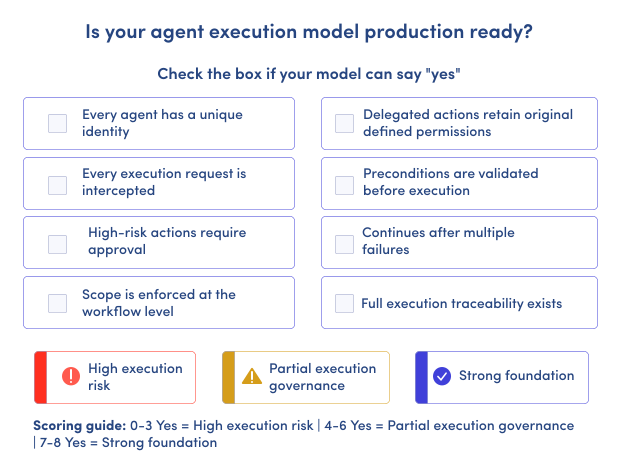
Is Your Agent Execution Model Production-Ready?
Check the box if you can say “Yes, we have it covered.”
- Every agent has a unique identity
- Every execution request is intercepted
- High-risk actions require approval
- Scope is enforced at the workflow level
- Delegated actions retain original permissions
- Preconditions are validated before execution
- Recovery workflows are defined
- Full execution traceability exists
Your score:
- 0-3 Yes answers High execution risk.
- 4-6 Yes answers Partial execution governance.
- 7-8 Yes answers Strong foundation for production-scale AI agent execution.
Next Steps
Press Release
